
Sponsored by:

Visit AMD Visit Supermicro

Performance Intensive Computing

Capture the full potential of IT

How the New EPYC CPUs Deliver System-on-Chip Electronics

Featured content

How the New EPYC CPUs Deliver System-on-Chip Electronics

CPU chipsets are not normally considered systems-on-chip (SoC) but the fourth generation of AMD EPYC processors incorporate numerous I/O functionality at a high level of integration.

Learn More about this topic
  • Applications:
  • Featured Technologies:
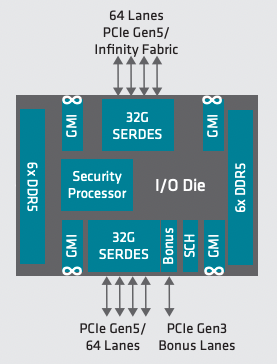
Typically, CPU chipsets are not normally considered systems-on-chip (SoC) but the fourth generation of AMD EPYC processors incorporate numerous I/O functionality at a high level of integration. Previous generations have delivered this functionality on external chipsets. The SoC design helps reduce power consumption, packaging costs and improve data throughput by reducing interconnection latencies.
 
The new EPYC processors have 12 DDR5 memory controllers – 50 percent more controllers than any other x86 CPU, which keeps up the higher memory demands of performance-intensive computing applications. As we mentioned in an earlier blog, these controllers also include inline encryption engines for supporting AMD’s Infinity Guard features, including support for an integrated security processor that establishes a secure root of trust and other security tasks.
 
They also include 128 or 160 lanes of PCIe Gen5 controllers, which also helps with higher I/O throughput of these more demanding applications. These support the same physical interfaces for Infinity fabric connectors and provide more remote memory access among CPUs at up to 36 GBps between servers. The new Zen 4 CPU cores can make use of one or two interfaces.
 
The PCIe Gen 5 I/O is supported in the I/O die with eight serializer/deserializer silicon controllers with one independent set of traces to support each port of 16 PCIe lanes.


Featured videos


Events


Find AMD & Supermicro Elsewhere

AMD’s Infinity Guard Selected by Google Cloud for Confidential Computing

Featured content

AMD’s Infinity Guard Selected by Google Cloud for Confidential Computing

Google Cloud has been working over the past several years with AMD on developing new on-chip security protocols. More on the release of the AMD EPYC™ 9004 series processors in this part three of a four-part series..

Learn More about this topic
  • Applications:
  • Featured Technologies:


Google Cloud has been working over the past several years with AMD on developing new on-chip security protocols that have seen further innovation with the release of the AMD EPYC™ 9004 series processors. These have a direct benefit for performance-intensive computing applications, particularly for supporting higher-density virtual machines (VMs) and using technologies that can protect data flows from leaving the confines of what Google calls confidential VMs as well as further isolating VM hypervisors. They offer a collection of N2D and C2D instances that support these confidential VMs.
 
“Product security is always our top focus,” said AMD CTO Mark Papermaster. “We are continuously investing and collaborating in the security of these technologies.” 
 
Royal Hansen, VP of engineering for Google Cloud said: “Our customers expect the most trustworthy computing experience on the planet. Google and AMD have a long history and a variety of relationships with the deepest experts on security and chip development. This was at the core of our going to market with AMD’s security solutions for datacenters.”
 
The two companies also worked together on this security analysis.
 
Called Infinity Guard collectively, the security technologies theyv'e been working on involve four initiatives:
 
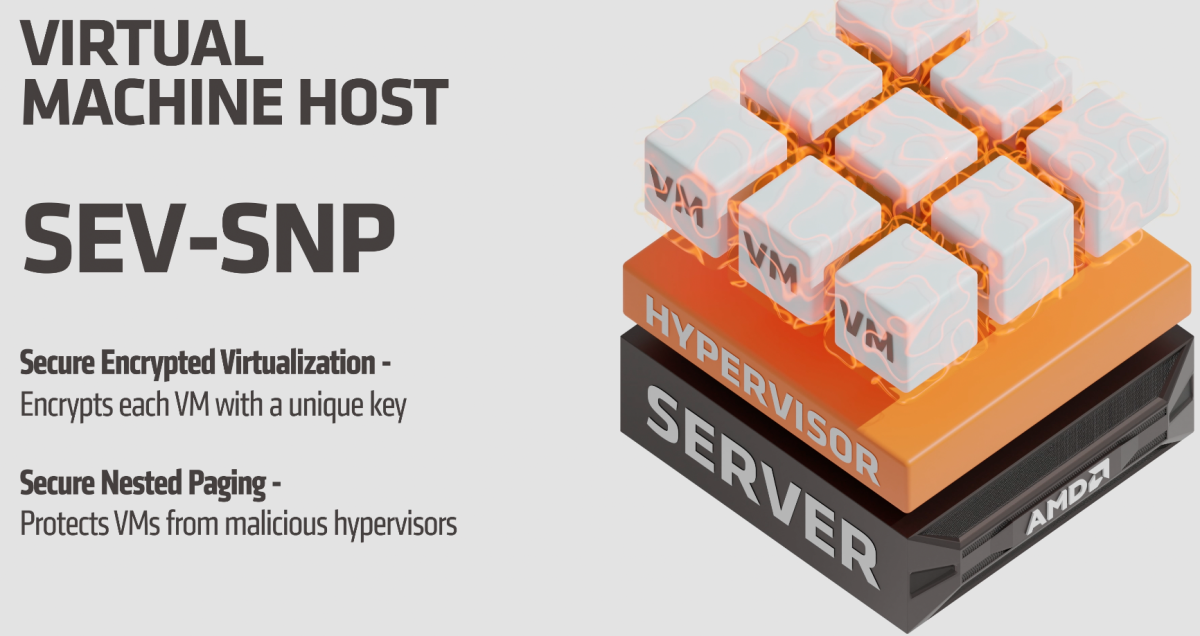
1. Secure encrypted virtualization provides each VM with its own unique encryption key known only to the processor.
 
2. Secure nested paging complements this virtualization to protect each VM from any malicious hypervisor attacks and provide for an isolated and trusted environment.
 
3. AMD’s secure boot along with the Trusted Platform Module attestation of the confidential VMs happen every time a VM boots, ensuring its integrity and to mitigate any persistent threats.
 
4. AMD’s secure memory encryption and integration into the memory channels speed performance.
 
These technologies are combined and communicate using the AMD Infinity Fabric pathways to deliver breakthrough performance along with better secure communications.
 

Featured videos


Events


Find AMD & Supermicro Elsewhere

Understanding the New Core Architecture of the AMD EPYC 9004 Series Processors

Featured content

Understanding the New Core Architecture of the AMD EPYC 9004 Series Processors

AMD’s announcement of its fourth generation EPYC 9004 Series processors includes major advances in how these chipsets are designed and produced. Part 2 of 4.

Learn More about this topic
  • Applications:
  • Featured Technologies:
AMD’s announcement of its fourth generation EPYC 9004 Series processors includes major advances in how these chipsets are designed and produced for delivering the highest performance levels. These advances involve using a hybrid multi-die architecture.
 
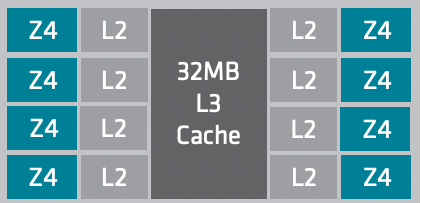
This architecture makes use of two different production processes for cores and I/O pathways. The former makes use of five nanometer dies, while the latter uses six nanometer dies. Each processor package can have up to 12 CPU dies, each with eight 8 cores for a total of 96 cores in the maximum configuration. Each eight-core assembly has its own set of eight 8 dedicated 1 MB L2 caches, and the overall assembly can access a shared 32 MB L3 cache, as shown in the diagram below.
 
32 MB L3 cache image


In addition to these changes, AMD announced improvements called Zen 4 that involve boosting instructions-per-clock counts and overall clock- speed increases. AMD promises roughly 29 percent faster single-core CPU performance in Zen 4 relative to Zen 3, which were affirmed with Ars Technica’s tests earlier this fall. (Zen 3 chips used the older seven 7 nanometer dies.)
 
 
This configuration provides a great deal of flexibility in how the CPU, memory channels, and I/O paths are arranged. The multi-die setup can reduce fabrication waste and offer better parallel processing support. In addition, AMD EPYC processors are produced in single and dual socket configurations, with the latter offering more I/O pathways and dedicated PCIe generation 5 I/O connections.
 

Featured videos


Events


Find AMD & Supermicro Elsewhere

AMD Announces Fourth-Generation EPYC™ CPUs with the 9004 Series Processors

Featured content

AMD Announces Fourth-Generation EPYC™ CPUs with the 9004 Series Processors

AMD announces its fourth-generation EPYC™ CPUs. The new EPYC 9004 Series processors demonstrate advances in hybrid, multi-die architecture by decoupling core and I/O processes. Part 1 of 4.

Learn More about this topic
  • Applications:
  • Featured Technologies:
AMD very recently announced its fourth-generation EPYC™ CPUs.This generation will provide innovative solutions that can satisfy the most demanding performance-intensive computing requirements for cloud computing, AI and highly parallelized data analytic applications. The design decisions AMD made on this processor generation strirke a good balance among specificaitons, including higher CPU power and I/O performance, latency reductions and improvements in overall data throughput. This lets a single CPU socket address an increasingly larger world of complex workloads. 
 
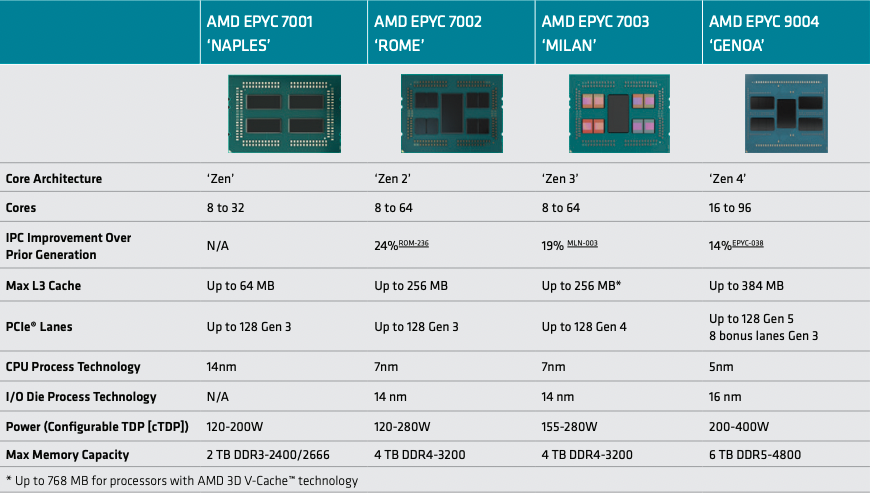
The new AMD EPYC™ 9004 Series processors demonstrate advances in hybrid, multi-die architecture by decoupling core and I/O processes. The new chip dies support 12 DDR5 memory channels, doubling the I/O throughput of previous generations. The new CPUs also increase core counts from 64 cores in the previous EPYC 7003 chips to 96 cores in the new chips using 5-nanometer processes. The new generation of chips also increases the maximum memory capacity from 4TB of DDR4-3200 to 6TB of DDR5-4800 memory.


There are three major innovations evident in the AMD EPYC™ 9004 processor series:
  1. A  new hybrid multi-die chip architecture coupled with multi-processor server innovations and a new and more advanced Zen 4 instruction set along with support for an increase in dedicated L2 and shared L3 cache storage
  2. Security enhancements to AMD’s Infinity Guard
  3. Advances to system-on-chip designs that extend and enhance AMD Infinity switching fabric technology,
Taken together, the new AMD EPYC™ 9004 series processors can offer plenty of innovation and performance advantage. The new processors offer better performance per watt of power consumed and better per core performance, too.
 

Featured videos


Events


Find AMD & Supermicro Elsewhere

Unlocking the Value of the Cloud for Mid-size Enterprises

Featured content

Unlocking the Value of the Cloud for Mid-size Enterprises

Learn More about this topic
  • Applications:
  • Featured Technologies:
  • Featured Companies:
  • Microsoft Azure

Organizations around the world are requiring new options for their next-generation computing environments. Mid-size organizations, in particular, are facing increasing pressure to deliver cost-effective, high-performance solutions within their hyperconverged infrastructures (HCI). Recent collaboration between Supermicro, Microsoft Azure and AMD, leveraging their collective technologies, has created a fresh approach that lets enterprises maintain performance at a lower operational cost while helping to reduce the organization’s carbon footprint in support of sustainability initiatives. This cost-effective, 1U system (a 2U version is available) offers both power, flexibility and modularity in large-scale GPU deployments.

The results of the collaboration combine the latest technologies, supporting multiple CPU, GPU, storage and networking options optimized to deliver uniquely configured and highly scalable systems. The product can be optimized for SQL and Oracle databases, VDI, productivity applications and database analytics. This white paper explores why this universal GPU architecture is an intriguing and cost-effective option for CTOs and IT administrators who are planning to rapidly implement hybrid cloud, data center modernization, branch office/edge networking or Kubernetes deployments at scale.

Get the 7-page white paper that provides the detail to assess the solution for yourself, including the new Azure Stack HCI certified system, specifications, cost justification and more.


Featured videos


Events


Find AMD & Supermicro Elsewhere

Enter Your Animation in Pixar’s RenderMan NASA Space Images Art Challenge

Featured content

Enter Your Animation in Pixar’s RenderMan NASA Space Images Art Challenge

For the first time, challengers can run their designs using thousands of AMD EPYC™ core CPUs, enabling artists to develop the most complex animations and the most amazing visualizations. “The contestants have access to this professional-grade render farm just like the pros. It levels the playing field,” said James Knight, the director of entertainment for AMD. “You can make scenes that weren’t possible before on your own PC,” he said.

Learn More about this topic
  • Applications:
  • Featured Technologies:
  • Featured Companies:
  • Pixar

One of the biggest uses of performance-intensive computing is the creation of high-resolution graphic animations used for entertainment and commercial applications. To that end, AMD and Pixar Animation Studios have announced the ninth RenderMan Art Challenge, which is open to the public. The idea is to encourage creative types to use some of the same tools that professional graphic designers and animators use to build something based on actual NASA data.


The winners will be determined by a set of Pixar, NASA and Industrial Light and Magic judges. The projects must be submitted by November 15 and the winning entries will be announced at the end of November.


This year’s challenge provides access to the AMD virtual Azure virtual machines, letting contestants use the highest-performing compute instances. Contestants will be given entrance to The AMD Creator Cloud, a render farm powered by Azure HBv3 composed of high-performance AMD EPYC™ processors using AMD 3D V-Cache™ technology.


For the first time, challengers can run their designs using thousands of AMD EPYC™ core CPUs, enabling artists to develop the most complex animations and the most amazing visualizations. “The contestants have access to this professional-grade render farm just like the pros. It levels the playing field,” said James Knight, the director of entertainment for AMD. “You can make scenes that weren’t possible before on your own PC,” he said.


The topic focus for this year’s challenge is space-related, in keeping with NASA’s involvement. The challenge provides scientifically accurate 3D NASA models, including telescopes, space stations, suits and planets. One of the potential advantages: many of past contests have ended up working at Pixar. “The RenderMan challenge gives everyone a chance to learn new things and show their abilities and creativity. The whole experience was great," said Khachik Astvatsatryan, a previous RenderMan Challenge winner.


Dylan Sisson, a RenderMan digital artist at Pixar, said “With the advancements we are seeing in hardware and software, individual artists are now able to create images of ever-increasing sophistication and complexity. It is a great opportunity for challengers to unleash their creative vision with these state-of-the-art technologies."

Featured videos


Events


Find AMD & Supermicro Elsewhere

The Perfect Combination: The Weka Next-Gen File System, Supermicro A+ Servers and AMD EPYC™ CPUs

Featured content

The Perfect Combination: The Weka Next-Gen File System, Supermicro A+ Servers and AMD EPYC™ CPUs

Weka’s file system, WekaFS, unifies your entire data lake into a shared global namespace where you can more easily access and manage trillions of files stored in multiple locations from one directory.

Learn More about this topic
  • Applications:
  • Featured Technologies:
  • Featured Companies:
  • Weka.io

One of the challenges of building machine learning (ML) models is managing data. Your infrastructure must be able to process very large data sets rapidly as well as ingest both structured and unstructured data from a wide variety of sources.


That kind of data is typically generated in performance-intensive computing areas like GPU-accelerated applications, structural biology and digital simulations. Such applications typically have three problems: how to efficiently fill a data pipeline, how to easily integrate data across systems and how to manage rapid changes in data storage requirements. That’s where Weka.io comes into play, providing higher-speed data ingestion and avoiding unnecessary copies of your data while making it available across the entire ML modeling space.


Weka’s file system, WekaFS, has been developed just for this purpose. It unifies your entire data lake into a shared global namespace where you can more easily access and manage trillions of files stored in multiple locations from one directory. It works across both on-premises and cloud storage repositories and is optimized for cloud-intensive storage so that it will provide the lowest possible network latencies and highest performance.


This next-generation data storage file system has several other advantages: it is easy to deploy, entirely software-based, plus it is a storage solution that provides all-flash level performance, NAS simplicity and manageability, cloud scalability and breakthrough economics. It was designed to run on any standard x86-based server hardware and commodity SSDs or run natively in the public cloud, such as AWS.


Weka’s file system is designed to scale to hundreds of petabytes, thousands of compute instances and billions of files. Read and write latency for file operations against active data is as low as 200 microseconds in some instances.


Supermicro has produced its own NVMe Reference Architecture that supports WekaFS on some of its servers, including the Supermicro A+ AS-1114S-WN10RT and AS-2114S-WN24RT using the AMD EPYC™ 7402P processors with at least 2TB of memory, expandable to 4TB. Both servers support hot-swappable NVMe storage modules for ultimate performance. Also check out the Supermicro WekaFS A/I and HPC Solution Bundle.


Featured videos


Events


Find AMD & Supermicro Elsewhere

Microsoft Azure’s More Capable Compute Instances Take Advantage of the Latest AMD EPYC™ Processors

Featured content

Microsoft Azure’s More Capable Compute Instances Take Advantage of the Latest AMD EPYC™ Processors

Azure HBv3 series virtual machines (VMs) are optimized for HPC applications, such as fluid dynamics, explicit and implicit finite element analysis, weather modeling, seismic processing, and various simulation tasks. HBv3 VMs feature up to 120 Third-Generation AMD EPYC™ 7v73X-series CPU cores with more than 450 GB of RAM.

Learn More about this topic
  • Applications:
  • Featured Technologies:
  • Featured Companies:
  • Azure

Increasing demands for higher-performance computing mean that the cloud-based computing needs to ratchet up its performance too. Microsoft Azure has introduced more capable compute virtual machines (VMs) that take advantage of the latest from AMD EPYC™ processors. This means that developers can easily spin up VMs that normally cost thousands of dollars if they were to purchase their physical equivalents.


This story's focus is on two of Azure's series: HBv3 and NVv4. In most cases, a single virtual machine is used to take advantage of all its resources. High-performance examples of Azure HBv3 series VMs are optimized for HPC applications, such as fluid dynamics, explicit and implicit finite element analysis, weather modeling, seismic processing, and various simulation tasks. HBv3 VMs feature up to 120 Third-Generation AMD EPYC™ 7v73X-series CPU cores with more than 450 GB of RAM. This series of VMs has processor clock frequencies up to 3.5GHz. All HBv3-series VMs feature 200Gb/sec HDR InfiniBand switches to enable supercomputer-scale HPC workloads. The VMs are connected and optimized to deliver the most consistent performance. Get more information about AMD EPYC and Microsoft Azure virtual machines.


A Dutch construction company, TBI, is using the Azure NVv4 to run computer-aided design and building modeling tasks on a series of virtual Windows desktops. The NVv4 VMs are only available running Windows powered by from four to 32 AMD EPYC™ vCPUs and offering a partial to full AMD Instinct™ M125 GPU with memory ranging from 2GB to 17GB. Previous generations of NV instances used Intel CPUs and NVIDIA GPUs that offer less performance.


TBI chose this solution because it was cheaper, easier to support and keep its software collection updated. Using virtual desktops meant that no client data was stored on any laptops, making things more secure. Also, these instances delivered equivalent performance, taking advantage of the SR-IOV technology.


Supermicro offers a wide range of servers that incorporate the AMD EPYC™ CPU and a number of servers optimized for applications that use GPUs. These servers range from 1U rackmount servers to high end 4U GPU optimized systems. Whether you’re using it on-prem or you’re building your own cloud, Supermicro’s Aplus servers are optimized for performance and technical computing applications and they run Azure and other systems well. Get more information about Supermicro servers with AMD’s EPYC™ CPUs.

Featured videos


Events


Find AMD & Supermicro Elsewhere

Supermicro and Qumulo Deliver High-Performance File Data Management Solution

Featured content

Supermicro and Qumulo Deliver High-Performance File Data Management Solution

Learn More about this topic
  • Applications:
  • Featured Technologies:
  • Featured Companies:
  • Qumulo

One of the issues that’s key to delivering higher-performing computing solutions is something that predates the PC itself: managing distributed file systems. The challenge becomes more acute when the applications involve manipulating large quantities of data. The tricky part is in how they scale to support these data collections, which might consist of video security footage, life sciences data collections and other research projects.


Storage systems from Qumulo integrate well into a variety of existing environments, such as those involving multiple storage protocols and file systems. The company supports a wide variety of use cases that allow for scaling up and out to handle Petabyte data quantities. Qumulo can run at both the network edge, in the data center and on various cloud environments. Their systems run on Supermicro’s all non-volatile memory express (NVMe) platform, the highest performing protocol designed for manipulating data stored on SSD drives. The servers are built on 24-core 2.8 GHz AMD EPYC™ processors.


Qumulo provides built-in near real-time data analytics that let IT administrators predict storage trends and better manage storage capacity so that they can proactively plan and optimize workflows.


The product handles seamless file and object data storage, is hardware agnostic, and supports single data namespace and burstable computing running on the three major cloud providers (AWS, Google and Azure) with nearly instant data replication. Its distributed file system is designed to handle billions of files and works equally well on both small and large file sizes.


Qumulo also works on storage clusters, such as those created with Supermicro AS-1114S servers, which can accommodate up to 150TB per storage node. Qumulo Shift for Amazon S3 is a feature that lets users copy data to the Amazon S3 native format for easy access to AWS services if the required services are not available in an on-prem data center. 

For more information, see the white paper on the Supermicro and Qumulo High-Performance File Data Management and Distributed Storage solution, powered by AMD EPYC™ processors.

Featured videos


Events


Find AMD & Supermicro Elsewhere

Red Hat’s OpenShift Runs More Efficiently with Supermicro’s SuperBlade® Servers

Featured content

Red Hat’s OpenShift Runs More Efficiently with Supermicro’s SuperBlade® Servers

The Supermicro SuperBlade's advantage for the Red Hat OCP environment is that it supports a higher-density infrastructure and lower-latency network configuration, along with benefits from reduced cabling, power and shared cooling features. SuperBlades feature multiple AMD EPYC™ processors using fast DDR4 3200MHz memory modules.

Learn More about this topic
  • Applications:
  • Featured Technologies:
  • Featured Companies:
  • Red Hat

Red Hat’s OpenShift Container Platform (OCP) provides enterprise Kubernetes-bundled devops pipelines. It automates builds and container deployments and lets developers focus on application logic while leveraging best-of-class enterprise infrastructure.


OpenShift supports a broad range of programming languages, web frameworks, databases, connectors to mobile devices and external back ends. OCP supports cloud-native, stateless applications and traditional applications. Because of its flexibility and utility in running advanced applications, OCP has become one of the go-to places that support high-performance computing.


Red Hat’s OCP comes in several deployment packages, including as a managed service running on the major cloud platforms, as virtual machines, and on “bare metal” servers, meaning a user installs all the software needed for the platform and is the sole tenant of the server.


It’s that last use case in which Supermicro’s SuperBlade servers are especially useful. Their advantage is that they support a higher-density infrastructure and lower-latency network configuration, along with benefits from reduced cabling, power and shared cooling features.


The SuperBlade comes in an 8U chassis with room to accommodate up to 20 hot-pluggable nodes (processor, network and storage) in a variety of more than a dozen models that support serial-attached SCSI, ordinary SATA drives, and GPU processor modules. It sports multiple AMD EPYC™ processors using fast DDR4 3200MHz memory modules.

A chief advantage of the SuperBlade is that it can support a variety of higher-capacity OCP workload configurations and do so within a single server chassis. This is critical because OCP requires a variety of server roles to deliver its overall functionality, and having these roles working inside of a chassis means performance  and latency benefits. For example, you could partition a SuperBlade’s 20 nodes into various OCP components such as administrative, management, storage, worker, infrastructure and load balancer nodes, all operating within a single chassis. For deeper detail about running OCP on the SuperBlade, check out this Supermicro white paper.

Featured videos


Events


Find AMD & Supermicro Elsewhere

Pages