Sponsored by:

Visit AMD Visit Supermicro

Performance Intensive Computing

Capture the full potential of IT

Bergamo: a deeper dive into AMD’s new EPYC processor for cloud-native workloads

Featured content

Bergamo: a deeper dive into AMD’s new EPYC processor for cloud-native workloads

Bergamo is AMD’s first-ever server processor designed specifically for cloud-native workloads. Learn how it works.  


Learn More about this topic
  • Applications:
  • Featured Technologies:

Bergamo is the former codename for AMD’s new 4th gen EPYC 97X4 processors optimized for cloud-native workloads, which the company introduced earlier this month.

AMD is responding to the increasingly specialized nature of data center workloads by optimizing its server processors for specific workloads. This month AMD introduced two examples: Bergamo (97X4) for cloud and Genoa-X (9XX4X) for technical computing.

The AMD EPYC 97X4 processors are AMD’s first-ever designed specifically for cloud-native workloads. And they’re shipping now in volume to AMD’s hyperscale customers that include Facebook parent company Meta and partners including Supermicro.

Speaking of Supermicro, that company this week announced that the new AMD EPYC 97X4 processors can now be included in its entire line of Supermicro H13 AMD-based systems.

Zen mastery

The main difference between the AMD EPYC 97X4 and AMD’s general-purpose Genoa series processors comes down to the core chiplet. The 97X4 CPUs use a new design called “Zen 4c.” It’s an update on the AMD Zen 4 core used in the company’s Genoa processors.

Where AMD’s original Zen 4 was designed for the highest performance per core, the new Zen 4c has been designed for a sweet spot of both density and power efficiency.

As AMD CEO Lisa Su explained during the company’s recent Data Center and AI Technology Premier event, AMD achieved this by starting with the same RTL design as Zen 4. AMD engineers then optimized this physical layout for power and area. They also redesigned the L3 cache hierarchy for greater throughput.

The result: a design that takes up about 35% less area yet offers substantially better performance per watt.

Because the start from the Zen 4’s design, the new 97X4 processors are both software- and platform-compatible with Genoa. The idea is that end users can mix and match 97X4- and Genoa-based servers, depending on their specific workloads and computing needs.

Basic math

Another difference is that where Genoa processors offer up to 96 cores per socket, the new 97X4 processors offer up to 128.

Here’s how it’s done: Each AMD 97X4 system-on-chip (SoC) contains 8 core complex dies (CCDs). In turn, each CCD contains 16 Zen 4c cores. So 8 CCDs x 16 cores = a total of 128 cores.

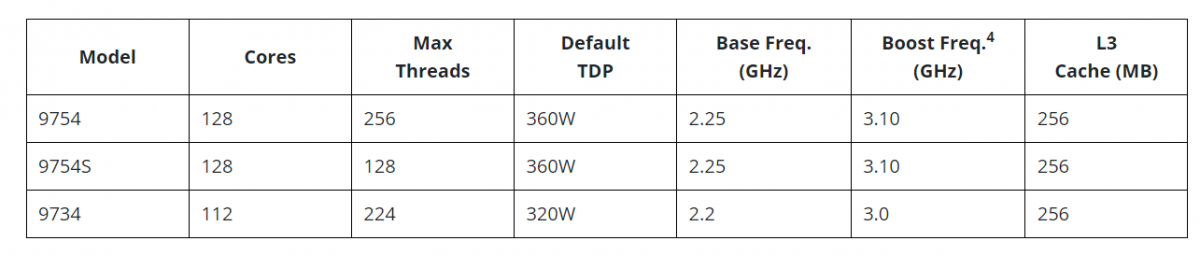
As the table below shows, courtesy of AMD, there are three SKUs for the new EPYC 97X5 series processors:

For security, all 3 SKUs support AMD Infinity Guard, a suite of hardware-level security features, and AMD Infinity Architecture, which lets system builders and cloud architects get maximum power while still ensuring security.

Are your customers looking for servers to handle their cloud-native applications? Tell them to look into the new AMD EPYC 97X4 processors.

Do more:


Featured videos


Events


Find AMD & Supermicro Elsewhere

AMD intros CPUs, cache, AI accelerators for cloud, enterprise data centers

Featured content

AMD intros CPUs, cache, AI accelerators for cloud, enterprise data centers

AMD strengthens its commitment to the cloud and enterprise data centers with new "Bergamo" CPUs, "Genoa-X" cache, Instinct accelerators.

Learn More about this topic
  • Applications:
  • Featured Technologies:

This week AMD strengthened its already strong commitment to the cloud and enterprise markets. The company announced several new products and partnerships at its Data Center and AI Technology Premier event, which was held in San Francisco and simultaneously broadcast online.

“We’re focused on pushing the envelope in high-performance and adaptive computing,” AMD CEO Lisa Su told the audience, “creating solutions to the world’s most important challenges.”

Here’s what’s new:

Bergamo: That’s the former codename for the new 4th gen AMD EPYC 97X4 processors. AMD’s first processor designed specifically for cloud-native workloads, it packs up to 128 cores per socket using AMD’s new Zen 4c design to deliver lots of power/watt. Each socket contains 8 chiplets, each with up to 16 Zen 4c cores; that’s twice as many cores as AMD’s earlier Genoa processors (yet the two lines are compatible). The entire lineup is available now.

Genoa-X: Another codename, this one is for AMD’s new generation of AMD 3D V-Cache technology. This new product, designed specifically for technical computing such as engineering simulation, now supports over 1GB of L3 cache on a 96-core CPU. It’s paired with the new 4th gen AMD EPYC processor, including the high-performing Zen4 core, to deliver high performance/core.

“A larger cache feeds the CPU faster with complex data sets, and enables a new dimension of processor and workload optimization,” said Dan McNamara, an AMD senior VP and GM of its server business.

In all, there are 4 new Genoa-X SKUs, ranging from 16 to 96 cores, and all socket-compatible with AMD’s Genoa processors.

Genoa: Technically, not new, as this family of data-center CPUs was introduced last November. But what is new is AMD’s new focus for the processors on AI, data-center consolidation and energy efficiency.

AMD Instinct: Though AMD had already introduced its Instinct MI300 Series accelerator family, the company is now revealing more details.

This includes the introduction of the AMD Instinct MI300X, an advanced accelerator for generative AI based on AMD’s CDNA 3 accelerator architecture. It will support up to 192GB of HBM3 memory to provide the compute and memory efficiency needed for large language model (LLM) training and inference for generative AI workloads.

AMD also introduced the AMD Instinct Platform, which brings together eight MI300X accelerators into an industry-standard design for the ultimate solution for AI inference and training. The MI300X is sampling to key customers starting in Q3.

Finally, AMD also announced that the AMD Instinct MI300A, an APU accelerator for HPC and AI workloads, is now sampling to customers.

Partner news: Mark your calendar for June 20. That’s when Supermicro plans to explore key features and use cases for its Supermicro 13 systems based on AMD EPYC 9004 series processors. These Supermicro systems will feature AMD’s new Zen 4c architecture and 3D V-Cache tech.

This week Supermicro announced that its entire line of H13 AMD-based systems are now available with support for the 4th gen AMD EPYC processors with Zen 4c architecture and V-Cache technology.

That includes Supermicro’s new 1U and 2U Hyper-U servers designed for cloud-native workloads. Both are equipped with a single AMD EPYC processor with up to 128 cores.

Do more:


Featured videos


Events


Find AMD & Supermicro Elsewhere

Absolute Hosting finds the sweet spot with AMD-powered Supermicro servers

Featured content

Absolute Hosting finds the sweet spot with AMD-powered Supermicro servers

Absolute Hosting, a South African provider of hosting services to small and midsize businesses, sought to upgrade its hardware, improve its performance, and lower its costs. The company achieved all three goals with AMD-powered Supermicro servers.

Learn More about this topic
  • Applications:
  • Featured Technologies:

Some brands are so strong, customers ask for them by name. They ask for a Coke when thirsty, click on Amazon.com when shopping online, visit a Tesla showroom when thinking of buying an electric car.

For Absolute Hosting Ltd., a South Africa-based provider of hosting and other digital services for small and midsize businesses (SMBs), it’s not one brand, but two: Supermicro and AMD. More specifically, the combination of Supermicro servers powered by AMD EPYC processors.

“Clients who have switched over to us have been amazed by the performance of our AMD EPYC-powered servers,” says Jade Benson, the founder of Absolute Hosting and now its managing director.

Benson and his colleagues find the Supermicro-AMD brand so powerful, they offer it by name. Check out Absolute Hosting's website, and you’ll see the AMD and Supermicro brands called out by name.

SMB specialists

It wasn’t always the case. Back in 2011, when Benson founded Absolute Hosting, the company served local South African tech resellers. Five years later, in 2016, the company shifted its focus to offering hosting and virtual server services to local SMBs.

One of its hosting services is virtual private servers. VPS hosting provides dedicated resources to each customer’s website, allowing for more control, customization and scalability than they’d get with shared hosting. That makes VPS hosting ideal for businesses that require lots of resources, enjoy high traffic, or need a great deal of control over their hosting environment.

Today Absolute Hosting owns about 100 physical servers and manages roughly 300 VPS servers for clients. The company also supplies its 5,000 clients with other hosting services, including Linux web, WordPress and email.

‘We kept seeing AMD’

Absolute Hosting’s shift to AMD-powered Supermicro servers was driven by its own efforts to refresh and upgrade its hardware, improve its performance and lower its own costs. Initially, the company rented dedicated servers from a provider that relied exclusively on Supermicro hardware.

“So when we decided to purchase our own hardware, we made it a requirement to use Supermicro,” Benson says. “And we kept seeing AMD as the recommended option.”

The new servers were a quick success. Absolute Hosting tested them with key benchmarks, including Cinebench, a cross-platform test suite, and Passmark, which compares the performance of CPUs. And it found them leading for every test application.

Absolute Hosting advertised the new offering on social media and quickly had enough business for 100 VPS servers. The company ran a public beta for customers and allowed the local IT community to conduct their own stress tests.

“The feedback we received was phenomenal,” Benson says. “Everyone was blown away.”

Packing a punch

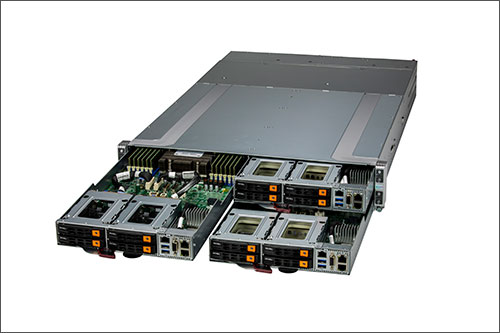
Absolute Hosting’s solution is based on Supermicro’s AS-2115GT-HNTF GrandTwin server. It packs four hot-pluggable nodes into a 2U rackmount form factor.

Each node includes an AMD EPYC CPU; 12 memory slots for up to 3TB of DDR5 memory; flexible bays for storage or I/O; and up to four hot-swap 2.5-inch NVMe/SATA storage drives.

Absolute Hosting currently uses the AMD EPYC 7003 Series processors. But the Supermicro server now supports the 4th gen AMD EPYC 9004 Series processors, and Benson plans to move to them soon.

Benson considers the AMD-powered Supermicro servers a serious competitive advantage. “There are only a few people we don’t tell about AMD,” he says. “That’s our competitors.”

Do more:


Featured videos


Events


Find AMD & Supermicro Elsewhere

Tech Explainer: How does Gaming as a Service work?

Featured content

Tech Explainer: How does Gaming as a Service work?

Gaming as a Service is a streaming platform that pushes content from the cloud to personal devices on demand. Though it’s been around for years, in some ways it’s just getting started.

Learn More about this topic
  • Applications:
  • Featured Technologies:

The technology known as Gaming as a Service has been around for 20 years. But in many ways it’s just getting started.

The technology is already enjoyed by literally millions of gamers worldwide. But new advances in AI and edge computing are making a big difference. So are faster, more consistent internet connections.

And coming soon should be a mix of virtual and augmented reality (VR & AR) headsets. They could bring gaming to a whole new level.

But how does GaaS work? Let’s take a look.

Cloud + edge = GaaS

GaaS is to video games what Netflix is to movies. Like Netflix, GaaS is a streaming platform that pushes content from the cloud to PCs, smartphones and other personal devices (including gaming consoles with the appropriate updates) on demand.

GaaS originates in the cloud. There, data centers packed with powerful servers maintain the gaming environment, process user commands, determine interaction between players and the virtual world, and deliver real-time results to players.

If the cloud is GaaS’s brains, then edge computing networks are its arms. They reach out to a worldwide base of users, connecting their devices to the gaming cloud.

Edge devices also keep things speedy by amplifying or, if necessary, taking over various processing duties. This helps reduce latency, the time lag between when a command is issued and when it’s executed.

Latency is especially detrimental to gamers. They rely on split-second actions that can make the difference between winning and losing. For them, lower latency is always better.

Device choice

GaaS is innovative at the user end, too. GaaS can interface with a wide array of client devices. That offers gamers far more flexibility than they get with traditional gaming models.

With GaaS, users are no longer tied to a specific gaming PC or console such as the Microsoft Xbox or Sony PlayStation. Instead, gamers can use any supported device with a decent GPU and a stable internet connection speed of at least 10 to 15 Mbps.

To be sure, some GaaS games—one example is the super-popular Fortnite—require a mobile or desktop app. But these apps are usually free.

Other cloud-based games are designed to work with any standard web browser. This lets a gamer pick up wherever they left off, using nearly any internet-connected device anywhere in the world.

Big business

If all this sounds attractive, it is. One of the first GaaS titles, World of Warcraft, is still active nearly 20 years after its initial launch. In 2015—the last time its publisher, Blizzard Entertainment, reported usage numbers—World of Warcraft had 5.5 million players.

Even more popular is Fortnite, introduced in 2017. Today it has more than 350 million registered users. In part, that’s because of the game’s flexible business model: Fortnite players can sign up and enjoy basic gameplay for free.

Instead of charging these users a fee, Fortnite’s developer, Epic Games, makes money from literally millions of micro-transactions. These include in-game purchases of weapons and accessories, access to tournaments and other gated experiences, and the purchase of a new “season,” released four times a year.

Super-popular games like Fortnite and World of Warcraft have help create a lucrative and compelling business model. This, in turn, has given rise to a new breed of GaaS tech providers.

One such operation is Blacknut, a France-based cloud gaming platform. Together with Australian outfit Radian Arc, Blacknut provides a GaaS digital infrastructure powered by AMD-based GPU servers designed and distributed by Supermicro.

What could go wrong?

Does GaaS have a downside? Sure. No platform is without its flaws.

For one, cloud gamers are at the mercy of the cloud. If a cloud provider experiences a slowdown or outage, a game can disappear until the issue is resolved.

For another, unlike a collection of game titles on physical media, GaaS gamers never really own the games they play. For example, if Epic decided to shut down Fortnite tomorrow, 350+ million gamers would have no choice but to look for alternate entertainment.

Internet access can be an issue, too. Those of us in first-world cities tend to take our high-speed connections for granted. The rest of the world may not be so lucky.

Future of GaaS

Looking ahead, the future of GaaS appears bright.

Advances in AI-powered cloud and edge computing will encourage game developers to create more nuanced and immersive content than ever before.

Faster and more consistent internet connections will help. They’ll give more power to both the bandwidth-hungry devices we use today and the shiny, new objects of desire we’ll clamor for tomorrow.

Tomorrow’s devices will surely include a mixture of VR and AR headsets. These could attach to other smart devices that enhance gameplay, like the interactive bodysuits foretold by movies such as Ready Player One.

GaaS will get smaller, too, as new mobile devices come to the market. Cloud-gaming titles, already a mainstay of mobile gamers, should be further empowered by next-generation mobile processors and faster, more reliable wireless data connections like 5G.

We’re witnessing the evolution of gaming as multiple clients interact with low latencies and high-quality graphics. Welcome to the future.


Featured videos


Events


Find AMD & Supermicro Elsewhere

Gaming as a Service gets a platform boost

Featured content

Gaming as a Service gets a platform boost

Gaming as a Service gets a boost from Blacknut’s new platform for content providers that’s powered by Supermicro and Radian Arc.

Learn More about this topic
  • Applications:
  • Featured Technologies:

Getting into Gaming as a Service? Cloud gaming provider Blacknut has released a new platform for content providers that’s powered by Supermicro and Radian Arc.

This comprehensive edge and cloud architecture provides content providers worldwide with bundled and fully managed game licensing, in-depth content metadata and a global hybrid-cloud solution.

If you’re not into gaming yet, you might want to be. Interactive entertainment and game streaming are on the rise.

Last year, an estimated 30 million paying users spent a combined $2.4 billion on cloud gaming services, according to research firm Newzoo. Looking ahead, Newzoo expects this revenue to more than triple by 2025, topping $8 billion. That would make the GaaS market an attractive investment for content providers.

What’s more, studies show that Gen Z consumers (aged 11 to 26 years old) spend over 12 hours a week playing video games. That’s more time than they spend watching TV, by about 30 minutes a week.

Paradigm shift

This data could signal a paradigm shift that challenges the dominance of traditional digital entertainment. That could include subscription video on demand (SVOD) such as Netflix as well as content platforms including ISPs, device manufacturers and media companies.

To help content providers capture younger, more tech-savvy consumers, Blacknut, Supermicro and Radian Arc are lending their focus to deploying a fully integrated GaaS platform. Blacknut, based in France, offers cloud-based gaming. Australia-based Radian Arc provides digital infrastructure and cloud game technology.

The system offers IT hardware solutions at the edge and the core, system management software and extensive IP. Blacknut’s considerable collection includes a catalog of over 600 AAA to indie games.

Blacknut is also providing white-glove services that include:

  • Onboard games wish lists and help establishing exclusive publisher agreements
  • Support for Bring Your Own Game (BYOG) and freemium game models
  • Assistance with the development of IP-licensed games designed in partnership with specialized studios
  • Marketing support to help providers develop go-to-market plans and manage subscriber engagement

The tech behind GaaS

Providers of cloud-based content know all too well the challenge of providing customers with high-availability, low-latency service. The right technology is a carefully choreographed ballet of hybrid cloud infrastructure, modern edge architecture and the IT expertise required to make it all run smoothly.

At the edge, Blacknut’s GaaS offering operates on Radian Arc’s GPU Edge Infrastructure-as-a-Service platform powered by Supermicro GPU Edge Infrastructure solutions.

These hardware solutions include flexible GPU servers featuring 6 to 8 directly attached GPUs and AMD EPYC processors. Also on board are cloud-optimized, scalable management servers and feature-rich ToR networking switches.

Combined with Blacknut’s public and private cloud infrastructure, an impressive array of hardware and software solutions come together. These can create new ways for content providers to quickly roll out their own cloud-gaming products and capture additional market share.

Going global

The Blacknut GaaS platform is already live in 45 countries and is expanding via distribution partnerships with over-the-top providers and carriers.

The solution can also be pre-embedded in set-top boxes and TV ecosystems. Indeed, it has already found its way onto such marquis devices as Samsung Gaming Hub, LG Gaming Shelf and Amazon FireTV.

To learn more about the Blacknut GaaS platform powered by Radian Arc and Supermicro, check out this new solution brief:


Featured videos


Events


Find AMD & Supermicro Elsewhere

Try before you buy with Supermicro’s H13 JumpStart remote access program

Featured content

Try before you buy with Supermicro’s H13 JumpStart remote access program

The Supermicro H13 JumpStart Remote Access program lets you and your customers test data-center workloads on Supermicro systems based on 4th Gen AMD EPYC 9004 Series processors. Even better, the program is free.

Learn More about this topic
  • Applications:
  • Featured Technologies:

You and your customers can now try out systems based on 4th Gen AMD EPYC 9004 Series processors at no cost with the Supermicro remote access program.

Called H13 JumpStart, the free program offers remote access to Supermicro’s top-end H13 systems.

Supermicro’s H13 systems are designed for today’s advanced data-center workloads. They feature 4th Gen AMD EPYC 9004 Series processors with up to 96 Zen 4 cores per socket, DDR5 memory, PCIe 5.0, and support for Compute Express Link (CXL) 1.1+ peripherals.

The H13 JumpStart program lets you and your customers validate, test and benchmark workloads on either of two Supermicro systems:

●      Hyper AS-2025HS-TNR: Features dual AMD EPYC processors, 24 DIMMS, up to 3 accelerator cards, AIOM network adapter, and 12 hot-swap NVMe/SAS/SATA drive bays.

●      CloudDC AS-2015CS-TNR: Features a single AMD processor, 12 DIMMS, 4 accelerator cards, dual AIOM network adapters, and a 240GB solid state drive.

Simple startup

Getting started with Supermicro’s H13 JumpStart program is simple. Just sign up with your name, email and a brief description of what you plan to do with the system.

Next, Supermicro will verify your information and your request. Assuming you qualify, you’ll receive a welcome email from Supermicro, and you’ll be scheduled to gain access to the JumpStart server.

Next, you’ll be given a unique username, password and URL to access your JumpStart account.

Run your test. Once you’re done, Supermicro will also ask you to complete a quick survey for your feedback on the program.

Other details

The JumpStart program does have a few limitations. One is the number of sessions you can have open at once. Currently, it’s limited to 1 VNC (virtual network computing), 1 SSH (secure shell), and 1 IPMI (intelligent platform management interface) session per user.

Also, the JumpStart test server is not directly addressable to the internet. However, the servers can reach out to the internet to get files.

You should test with JumpStart using anonymized data only. That’s because the Supermicro server’s security policies may differ from those of your organization.

But rest assured, once you’re done with your JumpStart demo, the server storage is manually erased, the BIOS and firmware are reflashed, and the OS is re-installed with new credentials. So your data and personal information are completely removed.

Get started

Ready to get a jump-start with Supermicro’s H13 JumpStart Remote Access program? Apply now to secure access.

Want to learn more about Supermicro’s H13 system portfolio? Check out a 5-part video series featuring Linus Sebastian of Linus Tech Tips. He takes a deep dive into how these Supermicro systems run faster and greener. 


Featured videos


Events


Find AMD & Supermicro Elsewhere

How rackscale integration can help your customers get productive faster

Featured content

How rackscale integration can help your customers get productive faster

Supermicro’s rack integration and deployment service can help your customers get productive sooner.


Learn More about this topic
  • Applications:
  • Featured Technologies:

How would your key data-center customers like to improve their server performance, speed their rate of innovation, and lower their organization’s environmental impact—all while getting productive sooner?

Those are among the key benefits of Supermicro’s rack integration and deployment service. It’s basically a one-stop shop for a defined process with experts to design and create an effective and efficient cloud and enterprise hardware solution.

Supermicro’s dedicated team can provide everything from early design to onsite integration. That includes design, assembly, configuration, testing and delivery.

Hardware covered by Supermicro’s rack integration service includes servers, storage, switches and rack products. That includes systems based on the latest 4th Generation AMD EPYC server processors. Supermicro’s experts can also work closely with your customer to design a test plan that includes application loading, performance tuning and testing.

All these can be used for a wide range of optimized solutions. These include AI and deep learning, big data and Hadoop refreshes, and vSAN.

Customers of Supermicro’s rackscale systems can also opt for liquid cooling. This can reduce your customer’s operating expenses by more than 40%. And by lowering fan speeds, liquid cooling can further reduce their power needs, delivering a PUE (power usage effectiveness metric) of close to 1.0. All that typically provides an ROI in just 1 year, according to Supermicro.

Five-phase integration

When your customers work with Supermicro on rack integration, they’ll get support through 5 phases:

  • Design: Supermicro learns your customer’s business problems and requirements, develops a proof-of-concept to validate the solution, then selects the most suitable hardware and works with your customer on power requirements and budgets. Then it creates a bill of materials, followed by a detailed rack-level engineering diagram.
  • Assembly: Supermicro technicians familiar with the company’s servers assemble the system, either on your customer’s site or pre-shipment at a Supermicro facility. This includes all nodes, racks, cabling and third-party equipment.
  • Configuration: Each server’s BIOS is updated, optimized and tested. Firmware gets updated, too. OSes and custom images are pre-installed or deployed to specific nodes as needed.
  • Testing: This includes a performance analysis, a check for multi-vendor compatibility, and full rack burn-in testing for a standard 8 hours.
  • Logistics: Supermicro ships the complete system to your customer’s site, can install it, and provides ongoing customer service.

Big benes

For your customers, the benefits of working with Supermicro and AMD can include better performance per watt and per dollar, faster time to market with IT innovation, a reduced environmental impact, and lower costs.

Further, once the system is installed, Supermicro’s support can significantly reduce lead times to fix system issues. The company keeps the whole process from L6 to L12 in-house, and it maintains a vast inventory of spare parts on campus.

Wherever your customers are located, Supermicro likely has an office nearby. With a global footprint, Supermicro operates across the U.S., EMEA and Taiwan. Supermicro has invested heavily in rack-integration testing facilities, too. These centers are now being expanded to test rack-level air and liquid cooling.

For your customers with cloud-based systems, there are additional benefits. These include optimizing the IT environment for their clouds, and meeting co-location requirements.

There’s business for channel partners, too. You can add specific software to the rack system. And you can work with your customer on training and more.

Do more:


Featured videos


Events


Find AMD & Supermicro Elsewhere

What are Your Server Customers Looking For? It Depends on Who They Are

Featured content

What are Your Server Customers Looking For? It Depends on Who They Are

While hyperscalers and enterprises both buy servers powered by the latest CPUs, their purchase decisions are based on very different criteria. Knowing who you’re selling to, and what they’re looking for, can make all the difference.

Learn More about this topic
  • Applications:
  • Featured Technologies:
Think all buyers of servers powered by the latest-generation CPUs are all looking for the same thing? Think again.
 
It pays to think of these customers as falling into one of two major groups. On the one hand are the so-called hyperscalers, those large providers of public cloud services. On the other are CIOs and other IT executives at large enterprises who are looking to improve their on-premises data centers. 
 
Customers in both groups are serious buyers of the latest, greatest servers. But their buying criteria? Two very different things.
 
Hyperscalers: TCO, x86, VM
 
When it comes to cutting-edge servers, hyperscalers including Amazon Web Services (AWS), Microsoft Azure and Google Cloud are attracted to the cost advantage.
 
As Mark Papermaster, chief technology officer at AMD, explained in a recent technology conference sponsored by Morgan Stanley, “For the hyperscalers, new server processors are an easy transition. Because they’re massive buyers, hyperscalers see the TCO [total cost of ownership] advantage.”
 
Hyperscalers also like the fact that most if not all new server CPUs still adhere to the x86 family of instruction-set architectures. “For their workloads,” Papermaster said, “it lifts and shifts.”
 
Big hyperscalers are also big implementers of containers and virtual machines. That’s an efficient workload application for today’s high-density CPUs. The higher the CPU density, the more VMs can be supported on a single server. 
 
For example, AMD’s 4th gen EPYC processors (formerly code-named Genoa) pack in 96 cores, or 50% more than the previous generation. That kind of density suits hyperscalers well, because they have such extensive inventories of VMs.
 
Enterprise CIOs: different priorities
 
For CIOs and other enterprise IT executives, server priorities and buying criteria are quite different. These buyers are looking mainly for ease of migration, broad ecosystem support, robust security and energy efficiency (which can also be a component of TCO). 
 
CIOs also need to keep their CFOs and boards happy, so they’re also looking for a clear and easily explainable return on investment (ROI). They may also need to tie this calculation to their organization’s strategic goals. For example, if a company were looking to increase its market share, the CIO might want to explain how purchasing new servers could help achieve that goal. 
 
One relatively new and increasingly important priority is energy efficiency. Enterprises increasingly need to demonstrate their support for “green” initiatives. One way a company can do that is by showing how their computer technology gets more done with less electric power.
 
Also, many data centers are already receiving as much electric power as they’re configured for. In other words, they can’t add power to get more work done. But they can add energy-efficient servers able to get more work done with the same or even less power than the systems they replace.
 
A third group, too
 
During his recent Morgan Stanley presentation, Papermaster of AMD also discussed a third group of server buyers: Organizations with hybrid IT orchestrations, both cloud and on-premises, that want the ability to move workloads back and forth. Essentially, this means mimicking the cloud in an on-prem environment.
 
Looking ahead, Papermaster discussed a forthcoming EPYC processor, code-named Bergamo, which he said is “right on track” to ship in this year’s first half. 
 
The new CPU will be aimed at cloud-native applications that need high levels of both throughput and per-socket performance. As previously announced, Bergamo will have up to 128 “Zen 4c” cores, and will come with the same software and security features as Genoa. 
 
“We listen to our customers,” Papermaster said, “and we see where workloads are going.” That’s a good practice for channel partners, too.
 
Do more:


Featured videos


Events


Find AMD & Supermicro Elsewhere

Research Roundup: Cloud Infrastructure, 9 Trends for Tech Providers, Euro IT Spending, RPA

Featured content

Research Roundup: Cloud Infrastructure, 9 Trends for Tech Providers, Euro IT Spending, RPA

Check out the latest analysis and forecasts from top IT market researchers. 

Learn More about this topic
  • Applications:

Cloud infrastructure spending is growing, but at a slower pace. Nine trends will have a huge impact on tech providers. European business leaders say they won’t let even a recession stop them from spending on tech. And RPA is forecast for fast growth.

That’s some of the latest analysis and forecasts from top IT market researchers. Here’s your research roundup.

Cloud Infrastructure Spending: Rising, But More Slowly  

Spending on cloud infrastructure grew 23% year-on-year in the fourth quarter of 2022, for a worldwide total of $65.8 billion, according to market watcher Canalys.

Impressive as that growth may sound, it represents a slowdown from the previous quarter. In last year’s third quarter, cloud-infrastructure spending worldwide rose by 34% year-on-year, an 11-point difference.

Three main factors were behind the dip, Canalys says. First was rising public-cloud costs, fueled by inflation, which encouraged organizations to review, and in some cases reduce, their spending. Second was uncertainty over the economy. And a third was “repatriation,” the act of taking certain workloads from the public cloud and returning them to private or co-location data centers.

By supplier, the cloud infrastructure market remained dominated by three big names, according to Canalys. In Q4:22, AWS led with a 32% market share, followed by Microsoft Azure (23%) and Google Cloud (10%). That left miscellaneous “others” with a collective 35% share.

9 Top Trends for Tech Providers

Nine trends will matter for tech providers through 2025, predicts research firm Gartner. These trends reflect 3 overarching themes: the increasing reliance of businesses on technology; new opportunities emerging through tech; and the impact of external macro forces. “The march of digitization continues even amidst disruption,” says Gartner researcher Rajesh Kandaswamy.

Here are Gartner’s top 9 trends for tech providers:

1. Democratization of Technology: Organizations are empowering non-IT workers to seek, implement and custom-fit their own tech.

2. Federated Enterprise Tech Buying: Buying decisions are increasingly made not by IT alone, but instead by representatives across the business.

3. Product-led Growth: This go-to-market strategy lets customers gain value via free product offers and interactive demos.

4. Co-innovation Ecosystems: Businesses and their tech providers collaborate to create unique, innovative solutions.

5. Digital Marketplaces: These help both technical and nontechnical buyers find, buy, implement and integrate technologies with ease.

6. Intelligent Applications: Advanced technologies such as generative AI create value and disrupt markets by learning, adapting and generating new ideas and outcomes.

7. Metaverse/Web3: Virtual environments are gaining traction as organizations look to create unique experiences, interactions and engagements.

8. Sustainability: Customers increasingly view sustainable products and practices as a “must have” rather than just a “nice to have.”

9. Techno-Nationalism: Selected regional markets are becoming more localized as new governmental policies aim for digital sovereignty.

Euro IT Spending: What Recession?

The European technology market is huge and growing.

Total IT spending in Europe will hit $1.2 trillion this year, predicts IDC. Looking ahead, the market intelligence firm expects that figure to top $1.4 trillion by 2026.

For the years 2021 to 2026, total IT spending in Europe will represent a compound annual growth rate (CAGR) of 5.4%, IDC expects. For this year alone, IDC predicts the year-on-year spending rise will be a somewhat lower 4.2%.

One remarkable aspect is that the forecasted spending rise comes as most European business leaders expect a recession. Nonetheless, IT spending will remain high, says IDC researcher Zsolt Simon, because European business leaders “regard technology investments as a means of gaining a competitive edge.”

By industry, banking remains Europe’s largest spender on IT, representing nearly 14% of all, says IDC. Looking ahead a few years, IDC expects the fastest-growing spender between now and 2026 will be professional services.

RPA Market Forecast: 40% Growth

Robotic process automation—software that makes it easy to build, deploy and manage software robots—is more than just a good idea. It’s also a booming market.

RPA sales worldwide will total $30.85 billion by 2030, representing a CAGR of nearly 40%, according to forecasts by Grand View Research.

New RPA sales will be driven primarily by customers looking to lower their operating costs, Grand View expects. But other goals for RPA include improved compliance and higher worker productivity.

In addition, the technology has gotten easier to use, even for complex processes. That should make RPA more attractive to potential customers, and more useful for them too.


Featured videos


Events


Find AMD & Supermicro Elsewhere

Part 4: The Web3 and Blockchain FAQ

Featured content

Part 4: The Web3 and Blockchain FAQ

This is the last in a four-part series on blockchain’s many facets, including being the primary pillar of the emerging Web3.

Learn More about this topic
  • Applications:

Part 1: First There Was Blockchain  |  Part 2: Delving Deeper into Blockchain  |  Part 3: Web3 Emerging

No matter how much information an article offers, sometimes you just want a fast, detail-complete answer to your burning question. Here’s nine more answers. We hope the answers to these frequently asked questions — along with the other three parts of the series — address any nagging Web3 and Blockchain questions you may have.


QUESTION: Is Web3, a methodology, a set of principles, a change in the way we do business, a trend, an idea, a philosophy, a fad?


ANSWER: I think Web3 is both philosophical and technical. Philosophical because awareness concerns over data privacy are growing with a few large entities gaining control of the lion’s share of data; prompting the desire for more decentralization. Technical processing and data storage is moved to the edge and decentralized with Web3, and networking is in a peer-to-peer architecture. Hence the catchphrase the edge is the new cloud. I think Web3 is the new Internet, and it's very disruptive. —Eric Frazier, senior solutions manager, Supermicro


QUESTION: What are the key benefits of Web3?


ANSWER:

1. Decentralization (peer to peer network and anyone can be connected with anyone directly

2. Trustless (no intermediary/middleman)

3. Permissionless (anyone can participate without authorization from a governing body

—Jörg Roskowetz, director product management blockchain technology, AMD


QUESTION: How should the data center of an enterprise be equipped to handle blockchain?


ANSWER 1: A tier 3 data center with proper redundancy is highly recommended as well as consistent bandwidth at 10 Gig minimum with 100 Gig recommended. —Michael Fair, chief revenue officer and longtime channel expert, PiKNiK


ANSWER 2: Typically, workstations with complementary GPU coprocessors. —Frazier


QUESTION: What are the benefits of NFTs?


ANSWER: There are several, here are the three more significant benefits: 

1. NFTs preserve the information necessary to support collection of royalties, even after multiple resales, with the proper smart contracts in place.


2. NFT’s could lead to the development and growth of a completely new creator economy in which music, video, art, book creators would be in control of their content sales, merchandising, they might even get tokenized payments for fan interaction and avoid any need to transfer ownership to platforms that publicize their content. The long line of business “partners” with their hands out awaiting their cut could be a thing of the past.


3. Inclusive growth: As NFTs bring content creators together into a shared market, a democratization of valuation will most likely occur that will benefit all participants.

—Frazier and Scot Finnie, managing editor, Performance-Intensive Computing


QUESTION: Does Blockchain or Web3 improve security?


ANSWER  1: First, Web3 user-to-platform interactions are confidential and anonymous, both in principle and in practice. This lets individuals realize their self-sovereignty and be assured of the security of their private information. Plus, Web3’s decentralized structure offers inherent security benefits because it eliminates the single point of failure. Blockchains are also composed of several built-in security qualities, such as cryptography, public and private keys, software-mediated consensus, contracts and identity controls. Bitcoin has not been hacked since its inception because the Bitcoin blockchain is constantly reviewed by the entire network. —Frazier


ANSWER  2: Blockchain-based data storage can defeat some types of ransomware, where the data itself is not sensitive but it is unique and irreplaceable. If your data storage system inherently gives you around-the-world redundancy that can survive flood, tornado, fire and so on, that’s increased data security. —Fair and Finnie


QUESTION: What are the advantages of storing enterprise data in a blockchain cloud storage service?


ANSWER: The value proposition for using a service like PiKNiK Web3 Cloud Storage is based on the following differences from traditional cloud storage providers:

1. Significantly lower costs

2. Immutability.  The blockchain monitors the data stored and reports back regularly to the customer verifying that the data has not been altered in any way. This is a free service; it’s part of the blockchain protocol.

3. Extra copies can be made anywhere in the world upon customer request. — Fair


QUESTION: What enterprise applications and make good sense for organizations to implement with blockchain?


ANSWER: An InterPlanetary File System (IPFS) storage system, supply chain, logistics, IP protection, licensing --Frazier and Roskowetz


QUESTION: What is the InterPlanetary File System and why does it matter?


ANSWER: The InterPlanetary File System was created by Juan Benet and was initially released as an alpha build in early 2015 (Wikipedia). Benet also founded Protocol Labs and is a Web3 advocate. It is believed that Benet was inspired for various aspects of the code by GitHub, BitTorrent and an MIT Distributed Hash Table (DHT). The DHT assigns a 24-digit immutable hash to identify content by name instead of by location. IPFS may be thought of as a replacement for the location-based addressing scheme that has underpinned the Web for 30 years—the HTTP protocol, written by Tim Berners-Lee. One of the key aspects of IPFS is that works like BitTorrent to leverage downloads by peers to preserve bandwidth. IPFS is a key piece of Web3 architecture. —Finnie


QUESTION: What are “dapps” (decentralized apps)?


ANSWER: Rich MacManus, writing for the New Stack, concluded that the problem with Web3 is dapps. It stands for decentralized app. Apparently, backend coding for a dapp is very different from traditional app coding and focuses on communication with smart contracts. What’s a dapp? Dapps serve the same purpose as apps written for other platforms except that they’re designed to run in a blockchain environment. For a recent list of top 10 Dapps see Geekflare. —Finnie


Other Stories in this Series:

Part 1: First There Was Blockchain

Part 2: Delving Deeper into Blockchain

Part 3: Web3 Emerging

Part 4: The Web3 and Blockchain FAQ

 

Featured videos


Events


Find AMD & Supermicro Elsewhere

Pages