

Sponsored by:

Visit AMD Visit Supermicro

Performance Intensive Computing

Capture the full potential of IT

Meet AMD’s new EPYC CPUs for SMBs—and Supermicro servers that support them

Featured content

Meet AMD’s new EPYC CPUs for SMBs—and Supermicro servers that support them

AMD introduced the AMD EPYC 4005 series processors for SMBs and cloud service providers. And Supermicro announced that the new AMD processors are now shipping in several of its servers.
Learn More about this topic
  • Applications:
  • Featured Technologies:

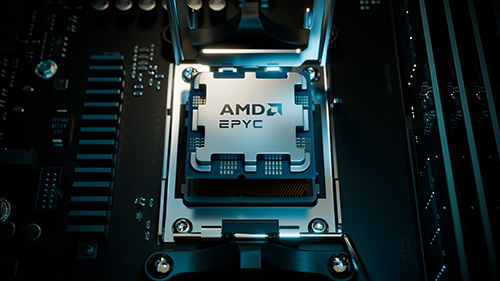
AMD this week introduced the AMD EPYC 4005 series processors. These are purpose-built CPUs designed to bring enterprise-level features and performance to small and medium businesses.

And Supermicro, wasting no time, also announced that several of its servers are now shipping with the new AMD EPYC 4005 CPUs.

EPYC 4005

The new AMD EPYC 4005 series processors are intended for on-prem users and cloud service providers who need powerful but cost-effective solutions in a 3U height form factor.
Target customers include SMBs, departmental and branch-office server users, and hosted IT service providers. Typical workloads for servers powered by the new CPUs will include general-purpose computing, dedicated hosting, code development, retail edge deployments, and content creation, AMD says.

“We’re delivering the right balance of performance, simplicity, and affordability,” says Derek Dicker, AMD’s corporate VP of enterprise and HPC. “That gives our customers and system partners the ability to deploy enterprise-class solutions that solve everyday business challenges.”

The new processors feature AMD’s ‘Zen 5’ core architecture and come in a single-socket package. Depending on model, they offer anywhere from 6 to 16 cores; up to 192GB of dual-channel DDR5 memory; 28 lanes of PCIe Gen 5 connectivity; and boosted performance of up to 5.7 GHz. One model of the AMD EPYC 4005 line also includes integrated AMD 3D V-Cache tech for a larger 128MB L3 cache and lower latency.

On a standard 42U rack, servers powered by AMD EPYC 4005 can provide up to 2,080 cores (that’s 13 3U servers x 10 nodes/server x 16 cores/node). That level of capacity can reduce a user’s size requirements while also lowering their TCO.

The new AMD CPUs follow the AMD EPYC 4004 series, introduced this time last year. The EPYC 4004 processors, still available from AMD, use the same AM5 socket as the 4005s.

Supermicro Servers

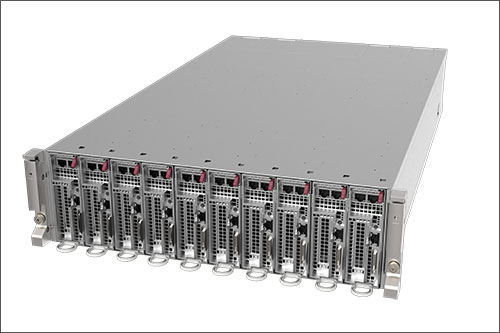
Also this week, Supermicro announced that several of its servers are now shipping with the new AMD EPYC 4005 series processors. Supermicro also introduced a new MicroCloud 3U server that’s available in 10-node and 5-node versions, both powered by the AMD EPYC 4005 CPUs.

"Supermicro continues to deliver first-to-market innovative rack-scale solutions for a wide range of use cases,” says Mory Lin, Supermicro’s VP of IoT, embedded and edge computing.

Like the AMD EPYC 4005 CPUs, the Supermicro servers are intended for SMBs, departmental and branch offices, and hosted IT service providers.

The new Supermicro MicroCloud 10-node server features single-socket AMD processors (your choice of either 4004 or the new 4005) as well as support for one single-width GPU accelerator card.

Supermicro’s new 5-node MicroCloud server also offers a choice of AMD EPYC 4004 or 4005 series processor. In contrast to the 10-node server, the 5-node version supports one double-width GPU accelerator card.

Supermicro has also added support for the new AMD EPYC 4005 series processors to several of its existing server lines. These servers include 1U, 2U and tower servers.

Have SMB, branch or hosting customers looking for affordable compute power? Tell them to:


Featured videos


Events


Find AMD & Supermicro Elsewhere

Tech Explainer: What are bare metal servers?

Featured content

Tech Explainer: What are bare metal servers?

Find out why bare metal servers are an important ingredient for cloud services providers—and why they sometimes offer big advantages over virtualized servers.

Learn More about this topic
  • Applications:

The term “bare metal” is an apt description for a server class that invites ground-up customization. These machines begin as a blank slate of just hardware. Later, they end up with the power to deliver high-performance computing for enterprise-level applications.

Cloud service providers (CSPs) such as AWS and Google Cloud make available bare metal to provide their customers with single-tenancy servers, virtual machines and containers.

Once a bare metal server is deployed, the end user can install any OS and application software that’s supported by the system. Then they can customize the system to suit their unique needs.

To bare, or not to bare

The customization options and raw power available via bare metal servers make them a particularly good solution for resource-intensive workloads. These includes AI training, machine learning, video rendering, 3D modeling, and complex scientific simulations such as those used to predict the effects of climate change.

These kinds of workloads require consistent CPU and GPU power, high-speed storage and a ton of RAM. With these resources in place, users are free to operate massive databases, data lakes and warehouses.

However, bare metal is not the ideal solution for every use case. It can be complex to set up, meaning a deployment can slow organizations looking for a quick turnaround or rapid pivot.

Most users will also need some experience with system management. That’s because setting up bare metal requires IT managers to install and configure an OS and other vital software from scratch.

Bare metal vs. virtual servers

When choosing between bare metal and virtual servers, IT managers must carefully weigh the pros and cons of each solution.

Virtual solutions can be faster and more agile than bare metal. They also cost less. That makes it easier to launch a project quickly, scale it as demand grows, and tear the whole thing down if things don’t go as planned.

Another pro for virtual solutions is the ability to more cost-effectively create a global deployment. This means IT managers can set up a worldwide network of edge locations or global content delivery network (CDN) distribution in minutes.

Bare metal servers don’t always offer the same speedy deployment. Creating a global network of bare metal servers can end up being more expensive and time-consuming than a virtual solution.

The power of single tenancy

So if virtual servers are so compelling, why opt instead for bare metal? The answer has much to do with what’s known as single tenancy.

Each bare metal server is deployed for a single end user. So the user has access to 100% of the server’s resources.

By comparison, virtual servers provisioned by CSPs are nearly always multi-tenant devices. That means users share the hardware and software resources of the server with other users.

This, in turn, can lead to the “noisy neighbor” effect. This occurs when an application or virtual machine uses the majority of available resources, causing performance issues for neighboring users.

Multi-tenancy also introduces additional security concerns. You can’t always be sure your neighbors are good people. On a virtual server, cyber criminals can more easily hack neighboring applications.

Denying access to those neighbors in the first place means single-tenancy bare metal servers present fewer threat vectors.

Is bare metal really bare?

No, not 100%. But it’s not far off.

As far as the customer of a cloud service provider is concerned, bare metal servers come as bare as they can possibly be.

But CSPs need a way to keep track of usage so they can charge customers accordingly. This is accomplished with a thin layer of software that exists outside the end user’s environment, and it may use a certain (low) number of cores on each CPU.

Using this software, the CSP can monitor server uptime and track bandwidth, processing and storage resources. The management software layer also empowers the provider to provision and reboot the system should the need arise.

Evolving Solutions

Enterprise-grade IT infrastructure is evolving at breakneck speed. That includes bare metal servers, which become faster and more flexible with the release of new processing and storage tech.

That could signal more cost-effective solutions for SMBs hoping to become enterprises if their products achieve mass adoption. After all, the world’s best app will always fail if you can’t serve the data fast enough.

Do More:


Featured videos


Events


Find AMD & Supermicro Elsewhere

Research Roundup: IT & cloud infrastructure spending rise, tech jobs stay strong, 2 security threats worsen

Featured content

Research Roundup: IT & cloud infrastructure spending rise, tech jobs stay strong, 2 security threats worsen

Catch up on the latest IT industry trends and statistics from leading market watchers and analysts.

Learn More about this topic
  • Applications:

Three of every four CFOs plan to increase their organizations’ IT spending this year. Spending on cloud infrastructure services rose 20% last year. Unemployment among IT workers is lower than the national average. And two types of cyber attacks are bigger threats than ever.

That’s some of the latest from leading IT industry watchers and researchers. And here’s your Performance Intensive Computing roundup.

CFOs: More IT Spending

If it’s true that a rising tide lifts all boats, you might prepare to set sail now. A new survey finds that a majority of corporate CFOs plan to boost their technology budgets this year.

The survey, conducted this past fall by research group Gartner, reached just over 300 CFOs and other senior finance leaders. Gartner published its findings this month, and they include:

  • Over three-quarters of CFOs surveyed (77%) plan to boost spending in the technology category this year.
  • Nearly half the CFOs (47%) plan to increase technology spending by 10% or more this year compared with last year.
  • Nearly a third (30%) plan to increase technology spending by 4% to 9% year-on-year.
  • And fewer than one in 10 CFOs (9%) plan to decrease technology spending this year.

Cloud Infrastructure: Spending Rises

One of those lifted ships: cloud infrastructure services.

In the fourth quarter of 2024, global spending on these services rose 20% year-on-year, according to new metrics from market watcher Canalys.

Global spending for the full year also rose 20%, Canalys said. Spending on cloud infrastructure services hit $321.3 billion last year, up from $267.7 billion in 2023.

The key driver of the growth? That would be AI. The technology “significantly accelerated” cloud adoption, Canalys says.

Looking ahead, Canalys expects global spending on cloud infrastructure services this year to rise by another 19%.

Tech Employment: Mostly Strong

Also on an upswing: technology employment.

New figures from the U.S. Bureau of Labor show that across all sectors of the U.S. economy, tech occupations grew by about 228,000 jobs.

Within the tech industry alone, the picture was more mixed. More than 13,700 jobs were filled in IT services and software development, but in telecom, 7,900 workers lost their jobs.

Tech is still a good industry to work in. The industry’s unemployment rate in January was 2.9%, compared with a national rate of 4%.

“Tech hiring activity was solid across the key categories,” says Tim Herbert, chief research officer at CompTIA, an industry trade group. “Employers continue to balance the need for foundational tech talent and skills with the push into next-gen fields.”

Security: Phishing, DDoS Both Worsen

Two kinds of cyber threats are getting worse:

  • The number of phishing attempts blocked worldwide last year by Kaspersky rose 26% over the previous year.
  • Distributed Denial of Services (DDoS) attacks increased by 82% last year, according to a new report from Zayo Group.

Kaspersky, a cybersecurity and digital privacy company, says it blocked more than 893 million phishing attempts last year, up from 710 million in 2023.

In many instances, the attackers mimicked the websites and social media feeds of well-known brands, including Airbnb, Booking and TikTok. Others falsely presented product giveaways from celebrities. In one, actress Jennifer Aniston was falsely shown promoting a giveaway of 10,000 laptop computers — a giveaway that did not exist.

Separately, Zayo Group, a provider of communications infrastructure, has published its biannual DDoS insights report, and the findings aren’t pretty. The attack volume rose from 90,000 incidents in 2023 to 165,000 incidents last year.

In a DDoS attack, the bad guys make a machine or network resource unavailable by disrupting the services of a host connected to a network. Often they do this by flooding the target system with requests, overloading the system and preventing requests that are legit from being fulfilled

In one worrisome change, the bad guys are increasing the scale of their DDoS attacks by using large botnets, compromised IoT devices and AI.

“The sophistication of DDoS attacks continues to grow,” says Max Clauson, a senior VP at Zayo. “Cybercriminals are finding ways to exploit cloud services, higher-bandwidth availability, and new vulnerabilities in software and network protocols.”

Also, Zayo finds the targets of DDoS attacks are shifting:

  • Telecom is still the most targeted sector, representing 42% of all observed incidents. But that’s down from 48% in 2023.
  • Attacks on the finance industry grew. In 2023 finance represented just 3.5% of all observed instances. In 2024 that doubled to 7%.
  • In healthcare, the total number of DDoS attacks more than tripled from 2023 to 2024, rising by a whopping 223%.


Featured videos


Events


Find AMD & Supermicro Elsewhere

Supermicro FlexTwin now supports 5th gen AMD EPYC CPUs

Featured content

Supermicro FlexTwin now supports 5th gen AMD EPYC CPUs

FlexTwin, part of Supermicro’s H14 server line, now supports the latest AMD EPYC processors — and keeps things chill with liquid cooling.


Learn More about this topic
  • Applications:
  • Featured Technologies:

Wondering about the server of the future? It’s available for order now from Supermicro.

The company recently added support for the latest 5th Gen AMD EPYC 9005 Series processors on its 2U 4-node FlexTwin server with liquid cooling.

This server is part of Supermicro’s H14 line and bears the model number AS -2126FT-HE-LCC. It’s a high-performance, hot-swappable and high-density compute system.

Intended users include oil & gas companies, climate and weather modelers, manufacturers, scientific researchers and research labs. In short, anyone who requires high-performance computing (HPC).

Each 2U system comprises four nodes. And each node, in turn, is powered by a pair of 5th Gen AMD EPYC 9005 processors. (The previous-gen AMD EPYC 9004 processors are supported, too.)

Memory on this Supermicro FlexTwin maxes out at 9TB of DDR5, courtesy of up to 24 DIMM slots. Expansions connect via PCIe 5.0, with one slot per node the standard and more available as an option.

The 5th Gen AMD EPYC processors, introduced last month, are designed for data center, AI and cloud customers. The series launched with over 25 SKUs offering up to 192 cores and all using AMD’s new “Zen 5” or “Zen 5c” architectures.

Keeping Cool

To keep things chill, the Supermicro FlexTwin server is available with liquid cooling only. This allows the server to be used for HPC, electronic design automation (EDA) and other demanding workloads.

More specifically, the FlexTwin server uses a direct-to-chip (D2C) cold plate liquid cooling setup, and each system also runs 16 counter-rotating fans. Supermicro says this cooling arrangement can remove up to 90% of server-generated heat.

The server’s liquid cooling also covers the 5th gen AMD processors’ more demanding cooling requirements; they’re rated at up to 500W of thermal design power (TDP). By comparison, some members of the previous, 4th gen AMD EPYC processors have a default TDP as low as 200W.

Build & Recycle

The Supermicro FlexTwin server also adheres to the company’s “Building Block Solutions” approach. Essentially, this means end users purchase these servers by the rack.

Supermicro says its Building Blocks let users optimize for their exact workload. Users also gain efficient upgrading and scaling.

Looking even further into the future, once these servers are ready for an upgrade, they can be recycled through the Supermicro recycling program.

In Europe, Supermicro follows the EU’s Waste Electrical and Electronic Equipment (WEEE) Directive. In the U.S., recycling is free in California; users in other states may have to pay a shipping charge.

Put it all together, and you’ve got a server of the future, available to order today.

Do More:


Featured videos


Events


Find AMD & Supermicro Elsewhere

AMD intros CPUs, accelerators, networking for end-to-end AI infrastructure -- and Supermicro supports

Featured content

AMD intros CPUs, accelerators, networking for end-to-end AI infrastructure -- and Supermicro supports

AMD expanded its end-to-end AI infrastructure products for data centers with new CPUs, accelerators and network controllers. And Supermicro is already offering supporting servers. 

Learn More about this topic
  • Applications:
  • Featured Technologies:

AMD today held a roughly two-hour conference in San Francisco during which CEO Lisa Su and other executives introduced a new generation of server processors, the next model in the Instinct MI300 Accelerator family, and new data-center networking devices.

As CEO Su told the audience the live and online audience, AMD is committed to offering end-to-end AI infrastructure products and solutions in an open, partner-dependent ecosystem.

Su further explained that AMD’s new AI strategy has 4 main goals:

  • Become the leader in end-to-end AI
  • Create an open AI software platform of libraries and models
  • Co-innovate with partners including cloud providers, OEMs and software creators
  • Offer all the pieces needed for a total AI solution, all the way from chips to racks to clusters and even entire data centers.

And here’s a look at the new data-center hardware AMD announced today.

5th Gen AMD EPYC CPUs

The EPYC line, originally launched in 2017, has become a big success for AMD. As Su told the event audience, there are now more than 950 EPYC instances at the largest cloud providers; also, AMD hardware partners now offer EPYC processors on more than 350 platforms. Market share is up, too: Nearly one in three servers worldwide (34%) now run on EPYC, Su said.

The new EPYC processors, formerly codenamed Turin and now known as the AMD EPYC 9005 Series, are now available for data center, AI and cloud customers.

The new CPUs also have a new core architecture known as Zen5. AMD says Zen5 outperforms the previous Zen4 generation by 17% on enterprise instructions-per-clock and up to 37% on AI and HPC workloads.

The new 5th Gen line has over 25 SKUs, and core count ranges widely, from as few as 8 to as many as 192. For example, the new AMD EPYC 9575F is a 65-core, 5GHz CPU designed specifically for GPU-powered AI solutions.

AMD Instinct MI325X Accelerator

About a year ago, AMD introduced the Instinct MI300 Accelerators, and since then the company committed itself to introducing new models on a yearly cadence. Sure enough, today Lisa Su introduced the newest model, the AMD Instinct MI325X Accelerator.

Designed for Generative AI performance and built on the AMD CDNA3 architecture, the new accelerator offers up to 256GB of HBM3E memory, and bandwidth up to 6TB/sec.

Shipments of the MI325X are set to begin in this year’s fourth quarter. Partner systems with the new AMD accelerator are expected to start shipping in next year’s first quarter.

Su also mentioned the next model in the line, the AMD Instinct MI350, which will offer up to 288GB of HBM3E memory. It’s set to be formally announced in the second half of next year.

Networking Devices

Forrest Norrod, AMD’s head of data-center solutions, introduced two networking devices designed for data centers running AI workloads.

The AMD Pensando Salina DPU is designed for front-end connectivity. It supports thruput of up to 400 Gbps.

The AMD Pensando Pollara 400, designed for back-end networks connecting multiple GPUs, is the industry’s first Ultra-Ethernet Consortium-ready AI NIC.

Both parts are sampling with customers now, and AMD expects to start general shipments in next year’s first half.

Both devices are needed, Norrod said, because AI dramatically raises networking demands. He cited studies showing that connectivity currently accounts for 40% to 75% of the time needed to run certain AI training and inference models.

Supermicro Support

Supermicro is among the AMD partners already ready with systems based on the new AMD processors and accelerator.

Wasting no time, Supermicro today announced new H14 series servers, including both Hyper and FlexTwin systems, that support the 5th gen AMD 9005 EPYC processors and AMD Instinct MI325X Accelerators.

The Supermicro H14 family includes three systems for AI training and inference workloads. Supermicro says the systems can also accommodate the higher thermal requirements of the new AMD EPYC processors, which are rated at up to 500W. Liquid cooling is an option, too.

Do More:


Featured videos


Events


Find AMD & Supermicro Elsewhere

Why CSPs Need Hyperscaling

Featured content

Why CSPs Need Hyperscaling

Today’s cloud service providers need IT infrastructures that can scale like never before.

Learn More about this topic
  • Applications:
  • Featured Technologies:

Hyperscaling IT infrastructure may be one of the toughest challenges facing cloud service providers (CSPs) today.

The term hyperscale refers to an IT architecture’s ability to scale in response to increased demand.

Hyperscaling is tricky, in large part because demand is a constantly moving target. Without much warning, a data center’s IT demand can increase exponentially due to a myriad of factors.

That could mean a public emergency, the failure of another CSP’s infrastructure, or simply the rampant proliferation of data—a common feature of today’s AI environment.

To meet this growing demand, CSPs have a lot to manage. That includes storage measured in exabytes, AI workloads of massive complexity, and whatever hardware is needed to keep system uptime as close to 100% as possible.

The hardware alone can be a real challenge. CSPs now oversee both air- and liquid-powered cooling systems, redundant power sources, diverse networking gear, and miles of copper and fiber-optic cabling. It’s a real handful.

Design with CSPs in Mind

To help CSPs cope with this seemingly overwhelming complexity, Supermicro offers purpose-built hardware designed to tackle the world’s most demanding workloads.

Enterprise-class servers like Supermicro’s H13 and A+ server series offer CSPs powerful platforms built to handle the rigors of resource-intensive AI workloads. They’ve been designed to scale quickly and efficiently as demand and data inevitably increase.

Take the Supermicro GrandTwin. This innovative solution puts the power and flexibility of multiple independent servers in a single enclosure.

The design helps lower operating expenses by enabling shared resources, including a space-saving 2U enclosure, heavy-duty cooling system, backplane and N+1 power supplies.

To help CSPs tackle the world’s most demanding AI workloads, Supermicro offers GPU server systems. These include a massive—and massively powerful—8U eight-GPU server.

Supermicro H13 GPU servers are powered by 4th-generation AMD EPYC processors. These cutting-edge chips are engineered to help high-end applications perform better and return faster.

To make good on those lofty promises, AMD included more and faster cores, higher bandwidth to GPUs and other devices, and the ability to address vast amounts of memory.

Theory Put to Practice

Capable and reliable hardware is a vital component for every modern CSP, but it’s not the only one. IT infrastructure architects must consider not just their present data center requirements but how to build a bridge to the requirements they’ll face tomorrow.

To help build that bridge, Supermicro offers an invaluable list: 10 essential steps for scaling the CSP data center.

A few highlights include:

  • Standardize and scale: Supermicro suggests CSPs standardize around a preferred configuration that offers the best compute, storage and networking capabilities.
  • Plan ahead for support: To operate a sophisticated data center 24/7 is to embrace the inevitability of technical issues. IT managers can minimize disruption and downtime when some-thing goes wrong by choosing a support partner who can solve problems quickly and efficiently.
  • Simplify your supply chain: Hyperscaling means maintaining the ability to move new infra-structure into place fast and without disruption. CSPs can stack the odds in their favor by choosing a partner that is ever ready to deliver solutions that are integrated, validated, and ready to work on day one.

Do More:

Hyperscaling for CSPs will be the focus of a session at the upcoming Supermicro Open Storage Summit ‘24, which streams live Aug. 13 - Aug. 29.

The CSP session, set for Aug. 20, will cover the ways in which CSPs can seamlessly scale their AI operations across thousands of GPUs while ensuring industry-leading reliability, security and compliance capabilities. The speakers will feature representatives from Supermicro, AMD, Vast Data and Solidigm.

Learn more and register now to attend the 2024 Supermicro Open Storage Summit.


Featured videos


Events


Find AMD & Supermicro Elsewhere

Supermicro intros MicroCloud server powered by AMD EPYC 4004 CPUs

Featured content

Supermicro intros MicroCloud server powered by AMD EPYC 4004 CPUs

Supermicro’s latest 3U server, the Supermicro MicroCloud, supports up to 10 nodes of AMD’s entry-level server processor. With this server and the high-density enclosure, Supermicro offers an efficient, high-density and affordable solution for SMBs, corporate departments and branches, and hosted IT service providers.

Learn More about this topic
  • Applications:
  • Featured Technologies:

Supermicro’s latest H13 server is powered by the AMD EPYC 4004 series processors introduced last month. Designated the Supermicro MicroCloud AS -3015MR-H10TNR, this server is designed to run cloud-native workloads for small and midsized businesses (SMBs), corporate departments and branch offices, and hosted IT service providers.

Intended workloads for the new server include web hosting, cloud gaming and content-delivery networks.

10 Nodes, 3U Form

This new Supermicro MicroCloud server supports up to 10 nodes in a 3U form factor. In addition, as many as 16 enclosures can be loaded into a single track, providing a total of 160 individual nodes.

Supermicro says customers using the new MicroCloud server can increase their computing density by 3.3X compared with industry-standard 1U rackmount servers at rack scale.

The new server also supports high-performance peripherals with either two PCIe 4.0 x8 add-on cards or one x16 full-height, full-width GPU accelerator. System memory maxes out at 192GB. And the unit gets air-cooled by five heavy-duty fans.

4004 for SMBs

The AMD EPYC 4004 series processors bring an entry-level family of CPUs to AMD’s EPYC line. They’re designed for use in entry-level servers used by organizations that typically don’t require either hosting on the public cloud or more powerful server processors.

The new AMD EPYC 4004 series is initially offered as eight SKUs, all designed for use in single-processor systems. They offer from 8 to 16 ‘Zen 4’ cores with up to 32 threads; 128MB of L3 cache; 2 DDR channels with a memory capacity of up to 192GB; and 28 lanes of PCIe 5 connectivity.

More Than One

Supermicro is also using the new AMD EPYC 4004 series processors to power three other server lines.

That includes a 1U server designed for web hosting and SMB applications. A 2U server aimed specifically at companies in financial services. And towers intended for content creation, entry-level servers, workstations and even desktops.

All are designed to be high-density, efficient and affordable. Isn’t that what your SMB customers are looking for?

Do More:


Featured videos


Events


Find AMD & Supermicro Elsewhere

AMD intros entry-level server CPUs for SMBs, enterprise branches, hosted service providers

Featured content

AMD intros entry-level server CPUs for SMBs, enterprise branches, hosted service providers

The new AMD EPYC 4004 processors extend the company’s ‘Zen 4’ core architecture into a line of entry-level systems for small and midsized businesses, schools, branch IT and regional providers of hosted IT services.

Learn More about this topic
  • Applications:
  • Featured Technologies:

AMD has just introduced the AMD EPYC 4004 processors, bringing a new entry-level line to its family of 4th gen server processors.

To deliver these new processors, AMD has combined the architecture of its Ryzen 7000 series processors with the packaging of its EPYC line of server processors. The result is a line of CPUs that lowers the entry-level pricing for EPYC-powered servers.

The AMD EPYC 4004 processors are designed for use in entry-level servers and towers, systems that typically retail for $1,500 to $3,000. That’s a price level affordable for most small and medium businesses, enterprise IT branches, public school districts, and regional providers of hosted IT services. It’s even less than the retail price for some high-end processor CPUs.

Many SMBs can’t afford either hosting on the public cloud or AMD’s more powerful server processors. As a result, they often make do with using PCs as servers. The new AMD processors aim to change that.

There are lots of reasons why a real server offers a better solution. These reasons include greater performance and scalability, higher rates of dependability and easier management.

Under the hood

The new AMD EPYC 4004 series is initially offered as eight SKUs, all designed for use in single-processor systems. They offer from 8 to 16 ‘Zen 4’ cores with up to 32 threads; 128MB of L3 cache; 2 DDR channels with a memory capacity of up to 192GB; and 28 lanes of PCIe 5 connectivity.

Two of the new SKUs—4584PX and 4484PX—offer AMD’s 128MB 3D V-Cache technology. As the name implies, V-Cache is a 3D vertical cache designed to offer faster interconnect density, greater energy efficiency and higher per-core performance for cache-hungry applications.

All the new AMD EPYC 4004 processors use AMD’s AM5 socket. That makes them incompatible with AMD’s higher-end EPYC 8004 and EPYC 9004 server processors, which use a different socket.

OEM support

AMD is working with several server OEMs to get systems built around the new EPYC 4004 processors to market quickly. Among these OEMs is Supermicro, which is supporting the new AMD CPUs in select towers and servers.

That includes Supermicro’s H13 MicroCloud system, a high-density, 3U rackmount system for the cloud. It has now been updated with additional performance offered by the AMD EPYC 4004.

Supermicro’s H13 MicroCloud retails for about $10K, making it more expensive than most entry-level servers. But unlike those less-expensive servers, the MicroCloud offers 8 single-processor nodes for applications requiring multiple discrete servers, such as e-commerce sites, code development, cloud gaming and content creation.

AMD says shipments of the new AMD EPYC 4004 Series processors, as well as of OEM systems powered by the new CPUs, are expected to begin during the first week of June. Pre-sales orders of the new processors, AMD adds, have already been strong.

Do more:


Featured videos


Events


Find AMD & Supermicro Elsewhere

10 best practices for scaling the CSP data center — Part 1

Featured content

10 best practices for scaling the CSP data center — Part 1

Cloud service providers, here are best practices—courtesy of Supermicro—to help you design and deploy rack-scale data centers. 

Learn More about this topic
  • Applications:
  • Featured Technologies:

Cloud service providers, here are 10 best practices—courtesy of Supermicro—that you can follow for designing and deploying rack-scale data centers. All are based on Supermicro’s real-world experience with customers around the world.

Best Practice No. 1: First standardize, then scale

First, select a configuration of compute, storage and networking. Then scale these configurations up and down into setups you designate as small, medium and large.

Later, you can deploy these standard configurations at various data centers with different numbers of users, workload sizes and growth estimates.

Best Practice No. 2: Optimize the configuration

Good as Best Practice No. 1 is, it may not work if you handle a very wide range of workloads. If that’s the case, then you may want to instead optimize the configuration.

Here’s how. First, run the software on the rack configuration to determine the best mix of CPUs, including cores, memory, storage and I/O. Then consider setting up different sets of optimized configurations.

For example, you might send AI training workloads to GPU-optimized servers. But a database application on a standard 2-socket CPU system.

Best Practice No. 3: Plan for tech refreshes 

When it comes to technology, the only constant is change itself. That doesn’t mean you can just wait around for the latest, greatest upgrade. Instead, do some strategic planning.

That might mean talking with key suppliers about their road maps. What are their plans for transitions, costs, supply chains and more?

Also consider that leading suppliers now let you upgrade some server components without having to replace the entire chassis. That reduces waste. That could also help you get more power from your current racks, servers and power requirements.

Best Practice No. 4: Look for new architectures

New architectures can help you increase power at lower cost. For example, AMD and Supermicro offer data-center accelerators that let you run AI workloads on a mix of GPUs and CPUs, a less costly alternative to all-GPU setups.

To find out if you could benefit from new architectures, talk with your suppliers about running proof-of-concept (PoC) trials of their new technologies. In other words, try before you buy.

Best Practice No. 5: Create a support plan

Sure, you need to run 24x7, but that doesn’t mean you have to pay third parties for all of that. Instead, determine what level of support you can provide in-house. For what remains, you can either staff up or outsource.

When you do outsource, make sure your supplier has tested your software stack before. You want to be sure that, should you have a problem, the supplier will be able to respond quickly and correctly.

Do more:


Featured videos


Events


Find AMD & Supermicro Elsewhere

10 best practices for scaling the CSP data center — Part 2

Featured content

10 best practices for scaling the CSP data center — Part 2

Cloud service providers, here are more best practices—courtesy of Supermicro—that you can follow for designing and deploying rack-scale data centers. 

Learn More about this topic
  • Applications:
  • Featured Technologies:

Cloud service providers, here are 5 more best practices—courtesy of Supermicro—that you can follow for designing and deploying rack-scale data centers. All are based on Supermicro’s real-world experience with customers around the world.

Best Practice No. 6: Design at the data-center level

Consider your entire data center as a single unit, complete with its range of both strengths and weaknesses. This will help you tackle such macro-level issues as the separation of hot and cold aisles, forced air cooling, and the size of chillers and fans.

If you’re planning an entirely new data center, remember to include a discussion of cooling tech. Why? Because the physical infrastructure needed for an air-cooled center is quite different than that needed for liquid cooling.

Best Practice No. 7: Understand & consider liquid cooling

We’re approaching the limits of air cooling. A new approach, one based on liquid cooling, promises to keep processors and accelerators running within their design limits.

Liquid cooling can also reduce a data center’s Power Usage Effectiveness (PUE) ratio, a measure of how much energy is used by a center’s computing equipment. This cooling tech can also minimize the need for HVAC cooling power.

Best Practice No. 8: Measure what matters

You can’t improve what you don’t measure. So make sure you are measuring such important factors as your data center’s CPU, storage and network utilization.

Good tools are available that can take these measurements at the cluster level. These tools can also identify both bottlenecks and levels of component over- or under-use.

Best Practice No. 9: Manage jobs better

A CSP’s data center is typically used simultaneously by many customers. That pretty much means using a job-management scheduler tool.

One tricky issue is over-demand. That is, what do you do if you lack enough resources to satisfy all requests for compute, storage or networking? A job scheduler can help here, too.

Best Practice No. 10: Simplify your supply chain

Sure, competition across the industry is a good thing, driving higher innovation and lower prices. But within a single data center, standardizing on just a single supplier could be the winning ticket.

This approach simplifies ordering, installation and support. And if something should go wrong, then you’ll have only the proverbial “one throat to choke.”

Can you still use third-party hardware as appropriate? Sure. And with a single main supplier, that integration should be simpler, too.

Do more:


Featured videos


Events


Find AMD & Supermicro Elsewhere

Pages