Tech Explainer: Why embedded systems for retail?
You’ll find embedded systems in thousands of retail locations—but only if you know where to look. Find out how these specialized servers work, why they make sense, and how your retail customers can get started using them.
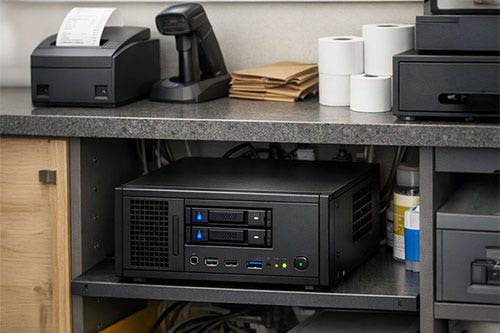
While dedicated high-performance servers and multiuse cloud platforms command the biggest headlines in tech news, that doesn’t mean they’re the perfect fit for every use case.
Retail organizations have unique requirements. Sometimes those requirements are best served by the diminutive, unsung heroes of the server world: embedded retail servers.
Embedded systems are usually smaller and less powerful than their larger, purpose-built cousins. So where giant AI servers may offer the brute force power of a freight train, smaller embedded systems are more like a ski lift. They do only one thing, but they do it very well.
You can find embedded systems in thousands of retail sites, but you’ll have to do some hunting—their location is not always obvious. Some embedded retail servers sit under counters or in small, out-of-the-way closets. Others are attached to the backs of large color displays that offer patrons dynamic menus, ads and special deals.
High-Tech Sales
One of the most common retail embedded systems is the humble point-of-sale (POS) terminal. A quick survey of your favorite retail stores is likely to reveal a variety of versions, ranging from smart cash registers to fully autonomous self-checkout kiosks.
But POS devices are designed to do far more than just add prices and calculate tax. In a modern retail setting, these servers may also read barcodes, weigh items, process mobile payments, update inventory, schedule deliveries, and detect fraud.
These processes can become even more demanding when the embedded system must complete them without the aid of cloud services.
Why? Because without the processing power and storage of remote cloud and core servers, the embedded system has to rely on its own internal components to complete what can often be a series of very demanding tasks.
Other Use Cases
Deploying embedded retail systems becomes even more complex when a retail location doubles as a warehouse. Such is the case with supermarkets and big-box retailers like Walmart. They must be able to quickly restock their shelves whenever supplies are depleted by shoppers.
In these locations, you can often find embedded retail servers keeping track of real-time stock levels. This can be accomplished using a number of methods, including radio frequency identification (RFID) tags, shelf-based weight sensors, and AI-enabled cameras.
Another task best handled by small, embedded systems is building and energy management. Retail operations often use embedded servers connected to distributed sensors to control HVAC, lighting and security. Here, again, it’s vitally important that these systems be able to operate without an internet connection when necessary.
In this case, an embedded server’s ability to operate on its own can actually prevent physical disasters. Even deprived of remote cloud services, it may need to keep control over a store’s climate to prevent damaging stock. Likewise, store managers often rely on an embedded server’s ability to maintain 100% security system uptime to avoid theft, damage or fire.
Power to Get the Job Done
Designers of embedded retail servers have a tricky job. They need to create systems that meet a long list of disparate requirements. That’s because the most effective embedded retail servers are:
- Compact enough to fit in small retail outlets
- Cost-effective enough that enterprises can outfit each location with multiple servers
- Powerful enough to handle multiple complex tasks and run AI applications locally
- Outfitted with enough storage to collect terabytes of data
- Reliable enough to run security services that store managers can rely on 24x7
- Able to reliably perform with or without an internet connection
To address these concerns, systems designers like Supermicro are tasked with creating the perfect balance of power, pricing, and reliability.
One such well-balanced embedded server is the upcoming Supermicro IoT A+ Server (AS-E300-14GR). It’s a mini-1U server powered by AMD EPYC 4004/4005 series processors with 16 cores and a 64MB cache.
Despite its small size, Supermicro’s embedded system still manages to offer some real expansion. For example, users can have Supermicro populate the server with up to 960GB of SSD storage and 192GB of DDR5 RAM. They can also opt for additional storage via the system’s dual M.2 PCIe 5.0 x4 NVMe slots.
In addition, there’s a single PCIe 5.0 x16 LP slot for an expansion card. Common options to fill that slot include PCIe-based networking cards and dedicated AI accelerators like AMD’s Instinct GPUs.
Coming Soon
What kind of features can we expect from future generations of embedded retail servers? The answer will have much to do with consumer shopping habits, economic and market shifts, and new tech that becomes available in the near future.
While we can’t make infallible predictions about those forces, we can make some assumptions.
One is that AI will become deeply integrated in embedded systems. In fact, we could soon see more systems with AI fully on-device—no cloud connection necessary.
Connectivity-wise, future embedded systems could feature not only Wi-Fi 7 integration, but also 5G cellular connections.
Embedded systems’ footprints should also shrink, even as they become more powerful. Ultra-low-power chips should enable them to operate silently with passive cooling systems and improved thermal management, which will allow designers to shrink the server’s overall size.
Bottom line: Expect embedded servers for retail to become smaller, faster and better. Isn’t that always the way when it comes to new technology?
Do More:
- Check out Supermicro AI-powered retail solutions
- Get tech specs on the Supermicro mini-1U embedded system with an AMD EPYC 4005 processor
- Meet the AMD EPYC 4005 series processors