



Sponsored by:

Visit AMD Visit Supermicro

Performance Intensive Computing

Capture the full potential of IT

AMD and Supermicro: Pioneering AI Solutions

Featured content

AMD and Supermicro: Pioneering AI Solutions

In the constantly evolving landscape of AI and machine learning, the synergy between hardware and software is paramount. Enter AMD and Supermicro, two industry titans who have joined forces to empower organizations in the new world of AI with cutting-edge solutions.

Learn More about this topic
  • Applications:
  • Featured Technologies:

Bringing AMD Instinct to the Forefront

In the constantly evolving landscape of AI and machine learning, the synergy between hardware and software is paramount. Enter AMD and Supermicro, two industry titans who have joined forces to empower organizations in the new world of AI with cutting-edge solutions. Their shared vision? To enable organizations to unlock the full potential of AI workloads, from training massive language models to accelerating complex simulations.

The AMD Instinct MI300 Series: Changing The AI Acceleration Paradigm

At the heart of this collaboration lies the AMD Instinct MI300 Series—a family of accelerators designed to redefine performance boundaries. These accelerators combine high-performance AMD EPYC™ 9004 series CPUs with the powerful AMD InstinctTM MI300X GPU accelerators and 192GB of HBM3 memory, creating a formidable force for AI, HPC, and technical computing.

Supermicro’s H13 Generation of GPU Servers

Supermicro’s H13 generation of GPU Servers serves as the canvas for this technological masterpiece. Optimized for leading-edge performance and efficiency, these servers integrate seamlessly with the AMD Instinct MI300 Series. Let’s explore the highlights:

8-GPU Systems for Large-Scale AI Training:

  • Supermicro’s 8-GPU servers, equipped with the AMD Instinct MI300X OAM accelerator, offer raw acceleration power. The AMD Infinity Fabric™ Links enable up to 896GB/s of peak theoretical P2P I/O bandwidth, while the 1.5TB HBM3 GPU memory fuels large-scale AI models.
  • These servers are ideal for LLM Inference and training language models with trillions of parameters, minimizing training time and inference latency, lowering the TCO and maximizing throughput.

Benchmarking Excellence

But what about real-world performance? Fear not! Supermicro’s ongoing testing and benchmarking efforts have yielded remarkable results. The continued engagement between AMD and Supermicro performance teams enabled Supermicro to test pre-release ROCm versions with the latest performance optimizations and publicly released optimization like Flash Attention 2 and vLLM. The Supermicro AMD-based system AS -8125GS-TNMR2 showcases AI inference prowess, especially on models like Llama-2 70B, Llama-2 13B, and Bloom 176B. The performance? Equal to or better than AMD’s published results from the Dec. 6 Advancing AI event.
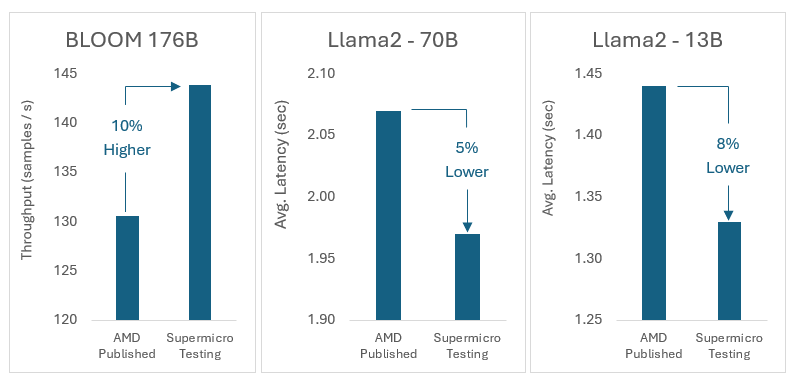
Image - Blog - AMD and Supermicro Pioneering AI Solutions

Charles Liang’s Vision

In the words of Charles Liang, President and CEO of Supermicro:

“We are very excited to expand our rack scale Total IT Solutions for AI training with the latest generation of AMD Instinct accelerators. Our proven architecture allows for fully integrated liquid cooling solutions, giving customers a competitive advantage.”

Conclusion

The AMD-Supermicro partnership isn’t just about hardware and software stacks; it’s about pushing boundaries, accelerating breakthroughs, and shaping the future of AI. So, as we raise our virtual glasses, let’s toast to innovation, collaboration, and the relentless pursuit of performance and excellence.

Featured videos


Events


Find AMD & Supermicro Elsewhere

AMD Announces Fourth-Generation EPYC™ CPUs with the 9004 Series Processors

Featured content

AMD Announces Fourth-Generation EPYC™ CPUs with the 9004 Series Processors

AMD announces its fourth-generation EPYC™ CPUs. The new EPYC 9004 Series processors demonstrate advances in hybrid, multi-die architecture by decoupling core and I/O processes. Part 1 of 4.

Learn More about this topic
  • Applications:
  • Featured Technologies:
AMD very recently announced its fourth-generation EPYC™ CPUs.This generation will provide innovative solutions that can satisfy the most demanding performance-intensive computing requirements for cloud computing, AI and highly parallelized data analytic applications. The design decisions AMD made on this processor generation strirke a good balance among specificaitons, including higher CPU power and I/O performance, latency reductions and improvements in overall data throughput. This lets a single CPU socket address an increasingly larger world of complex workloads. 
 
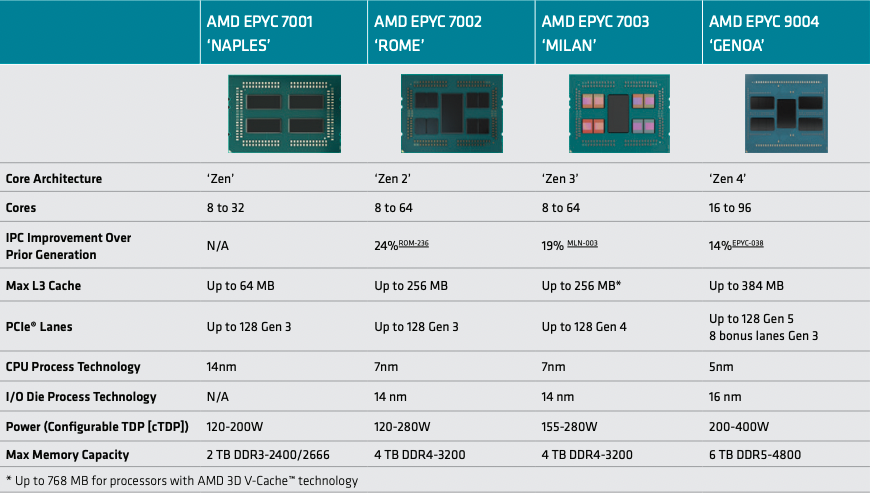
The new AMD EPYC™ 9004 Series processors demonstrate advances in hybrid, multi-die architecture by decoupling core and I/O processes. The new chip dies support 12 DDR5 memory channels, doubling the I/O throughput of previous generations. The new CPUs also increase core counts from 64 cores in the previous EPYC 7003 chips to 96 cores in the new chips using 5-nanometer processes. The new generation of chips also increases the maximum memory capacity from 4TB of DDR4-3200 to 6TB of DDR5-4800 memory.


There are three major innovations evident in the AMD EPYC™ 9004 processor series:
  1. A  new hybrid multi-die chip architecture coupled with multi-processor server innovations and a new and more advanced Zen 4 instruction set along with support for an increase in dedicated L2 and shared L3 cache storage
  2. Security enhancements to AMD’s Infinity Guard
  3. Advances to system-on-chip designs that extend and enhance AMD Infinity switching fabric technology,
Taken together, the new AMD EPYC™ 9004 series processors can offer plenty of innovation and performance advantage. The new processors offer better performance per watt of power consumed and better per core performance, too.
 

Featured videos


Events


Find AMD & Supermicro Elsewhere

Performance-Intensive Computing Helps Lodestar Computer Vision ‘Index’ Video Data

Featured content

Performance-Intensive Computing Helps Lodestar Computer Vision ‘Index’ Video Data

Lodestar is a complete management suite for developing artificial intelligence-based computer vision models from video data. It can handle the navigation and curation of a native video stream without any preparation. Lodestar annotates and labels video, and using artificial intelligence, creates searchable, structured data.

Learn More about this topic
  • Applications:
  • Featured Technologies:
  • Featured Companies:
  • Lodestar.ai, Juypter.org

Lodestar doesn’t call it indexing, but the company has a product that annotates video, and using artificial intelligence (AI), creates searchable, structured data. Lodestar offers a complete management suite for developing AI-based computer vision models from video data. The company’s technology includes continuous training of its AI models along with real-time active learning and labeling.


The challenge for computer vision efforts before Lodestar's technology came into the picture was the sheer amount of data contained in any video stream: an hour of video contains trillions of pixels. The result was a very heavy computational load to manipulate and analyze. That meant video had to be pre-processed before anyone could analyze the stream. But thanks to performance-intensive computing, there are new ways to host more capable and responsive tools.


That's where Lodestar comes into play, handling the navigation and curation of a native video stream without any preparation, using the video as a single source of truth. Metadata is extracted on the fly so that each video frame can be accessed by an analyst. This is a highly CPU-intensive process, and Lodestar uses Supermicro A+ servers running Jupyter’s data science applications across a variety of containers. These servers have optimized hardware that combines AMD CPU and GPU chipsets with the appropriate amount of memory to make these applications function quickly.


By harnessing this power, data scientists can now collaborate in real time to validate the dataset, run experiments, train models and guide annotation. With Lodestar, data scientists and domain experts can develop a production AI in weeks instead of months.


That’s what a leading European optical and hearing aid retailer did to help automate its in-store inventory management processes and keep track of its eyewear collection. Before the advent of Lodestar, each store’s staff spent 10 hours a month manually counting inventory. That doesn’t sound like much until you multiply the effort by 300 stores. With Lodestar, store inventory is completed in minutes. Given that the stores frequently update their product offerings, this has brought significant savings in labor, and more accurate inventory numbers have provided a better customer experience.

Featured videos


Events


Find AMD & Supermicro Elsewhere