


Sponsored by:

Visit AMD Visit Supermicro

Performance Intensive Computing

Capture the full potential of IT

Tech Explainer: What’s special about an AI server?

Featured content

Tech Explainer: What’s special about an AI server?

What’s in an AI server that a general-purpose system lacks?

Learn More about this topic
  • Applications:
  • Featured Technologies:

The Era of Artificial Intelligence requires its own class of servers, and rightly so. The AI tech that increasingly powers our businesses, finance, entertainment and scientific research is some of the most resource-intensive in history. Without AI servers, all this would grind to a halt.

But why? What’s so special about AI servers? And how are they able to power successive evolutions of large language models, generative AI, machine learning, and all the other AI-based workloads we’ve come to rely on day in and day out?

Put another way: What do AI servers have that standard servers don’t?

The answer can be summed up in a single word: More.

When it comes to AI servers, it’s all about managing a symphony. The musical instruments include multiple processors, GPUs, memory modules, networking hardware and expansion options.

Sure, your average general-purpose server has many similar components. But both the quantity and performance of each component is considerably lower than those of an AI server. That helps keep the price affordable, heat low, and workload options open. But it certainly doesn’t have the integrated GPU needed to run AI workloads.

Best of the Beasts

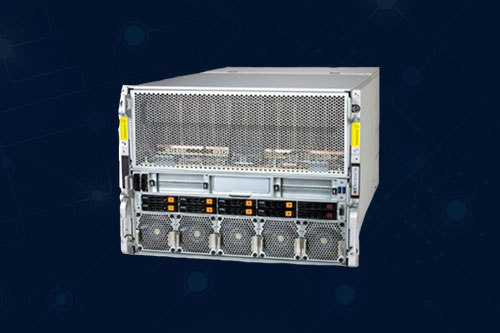
Supermicro specializes in the deployment of jaw-dropping power. The company’s newest 8U GPU Server (AS -8126GS-TNMR) is engineered to chew through the world’s toughest AI workloads. It’s powered by dual AMD EPYC processors and eight AMD Instinct MI350X or Instinct MI325X accelerators. This server can tackle AI workloads while staying cool and scaling up to meet increasing demand.

Keeping AI servers from overheating can be a tough job. Even a lowly, multipurpose business server kicks off a lot of heat. Temperatures build up around vital components like the CPU, GPU and storage devices. If that heat hangs around too long, it can lead to performance issues and, eventually, system failure.

Preventing heat-related issues in a single general-purpose server can be accomplished with a few heatsinks and small-diameter fans. But when it comes to high-performance, multi-GPU servers like Supermicro’s new 4U GPU A+ Server (AS -4126GS-NMR-LCC), liquid cooling becomes a must-have.

It’s also vital that AI servers be designed with expansion in mind. When an AI-powered app becomes successful, IT managers must be able to scale up quickly and without interruption.

Supermicro’s H14 8U 8-GPU System sets the standard for scalability. The H14 offers up to 20 storage drives and up to 12 PCI Express 5.0 (PCIe) x16 expansion slots.

Users can fill these high-bandwidth slots with a dizzying array of optional hardware, including:

  • Network Interface Cards (NICs) like the new AI-focused AMD AI NIC for high-speed networking.
  • NVMe storage to provide fast disk access.
  • Field Programmable Gate Array (FPGA) modules, which can be set up for custom computation and reconfigured after deployment.
  • Monitoring and control management cards. These enable IT staff to power servers on and off remotely, and also access BIOS settings.
  • Additional GPUs to aid in AI training and inferencing.
  • AI Accelerators. The AMD Instinct series is designed to tackle computing for AI, both training and inference.

A Different Class of Silicon

Hardware like the Supermicro GPU Server epitomizes what it means to be an AI server. That’s due in part to the components it’s designed to house. We’re talking about some of the most advanced processing tech available today.

As mentioned above, that tech comes courtesy of AMD, whose 5th Gen AMD EPYC 9005 series processors and recently announced AMD Instinct MI350 Series GPUs are powerful enough to tackle any AI workload.

AMD’s Instinct MI350 accelerators deliver a 4x generation-on-generation AI compute increase and a 35x generational leap in inferencing.

Say the word, and Supermicro will pack your AI Server with dual AMD EPYC processors containing up to 192 cores. They’ll install the latest AMD Instinct M1350X platform with 8 GPUs, fill all 24 DIMM slots with 6TB of DDR5 memory, and add an astonishing 16 NVMe U.2 drives. 

Advances Just Around the Corner

It seems like each new day brings stories about bold advances in AI. Apparently, our new robot friends may have the answer to some very human questions like, how can we cure our most insidious diseases? And how do we deal with the looming threat of climate crisis?

The AI models that could answer those questions—not to mention the ones that will help us find even better movies on Netflix—will require more power as they grow.

To meet those demands, AI server engineers are already experimenting with the next generation of advanced cooling for dense GPU clusters, enhanced hardware-based security, and new, more scalable modular infrastructure.

In fact, AI server designers have begun using their own AI models to create bigger and better AI servers. How very meta.

Do More:


Featured videos


Events


Find AMD & Supermicro Elsewhere

Meet Supermicro’s newest AI servers, powered by AMD Instinct MI350 Series GPUs

Featured content

Meet Supermicro’s newest AI servers, powered by AMD Instinct MI350 Series GPUs

Supermicro’s new AI servers are powered by a combination of AMD EPYC CPUs and AMD Instinct GPUs.

Learn More about this topic
  • Applications:
  • Featured Technologies:

Supermicro didn’t waste any time supporting AMD’s new Instinct MI350 Series GPUs. The same day AMD formally introduced the new GPUs, Supermicro announced two rack-mount servers that support them.

The new servers, members of Supermicro’s H14 generation of GPU optimized solutions, feature dual AMD EPYC 9005 CPUs along with the AMD Instinct MI350 series GPUs. They’re aimed at organizations looking to achieve a formerly tough combination: maximum performance at scale in their AI-driven data centers, but also a lower total cost of ownership (TCO).

To make the new servers easy to upgrade and scale, Supermicro has designed the new servers around its proven building-block architecture.

Here’s a quick look at the two new Supermicro servers:

4U liquid-cooled system with AMD Instinct MI355X GPU

This system, model number AS -4126GS-NMR-LCC, comes with a choice of dual AMD EPYC 9005 or 9004 Series CPUs, both with liquid cooling.

On the GPU front, users also have a choice of the AMD Instinct MI325X or brand-new AMD Instinct MI355X. Either way, this server can handle up to 8 GPUs.

Liquid cooling is provided by a single direct-to-chip cold plate. Further cooling comes from 5 heavy-duty fans and an air shroud.

8U air-cooled system with AMD Instinct MI350X GPU

This system, model number AS -8126GS-TNMR, comes with a choice of dual AMD EPYC 9005 or 9004 Series CPUs, both with air cooling.

This system also supports both the AMD Instinct MI325X and AMD Instinct MI350X GPUs. Also like the 4U server, this system supports up to 8 GPUs.

Air cooling is provided by 10 heavy-duty fans and an air shroud.

The two systems also share some features in common. These include PCIe 5.0 connectivity, large memory capacities (up to 2.3TB), and support for both AMD’s ROCm open-source software and AMD Infinity Fabric Link connections for GPUs.

“Supermicro continues to lead the industry with the most experience in delivering high-performance systems designed for AI and HPC applications,” says Charles Liang, president and CEO of Supermicro. “The addition of the new AMD Instinct MI350 series GPUs to our GPU server lineup strengthens and expands our industry-leading AI solutions and gives customers greater choice and better performance as they design and build the next generation of data centers.”

Do More:


Featured videos


Events


Find AMD & Supermicro Elsewhere

Oil & gas spotlight: Fueling up with AI

Featured content

Oil & gas spotlight: Fueling up with AI

AI is helping industry players that include BP, Chevron and Shell automate a wide range of important use cases. To serve them, AMD and Supermicro offer powerful accelerators and servers.

Learn More about this topic
  • Applications:
  • Featured Technologies:

What’s artificial intelligence good for? For managers in the oil and gas industry, quite a lot.

Industry players that include Shell, BP, ExxonMobil and Chevron are already using machine learning and AI. Use cases include predictive maintenance, seismic data analysis, reservoir management and safety monitoring, says a recent report by Chirag Bharadwaj of consultants Appinventiv.

AI’s potential benefits for oil and gas companies are substantial. Anurag Jain of AI consultants Oyelabs cites estimates of AI lowering oil production costs by up to $5 a barrel with a 25% productivity gain, and increasing oil reserves by as much as 20% with enhanced resource recovery.

Along the same lines is a recent report from market watcher Global Growth Insights. It says adoption of AI in North American oil shale drilling has increased production efficiency by an impressive 20%.

All this has led Jain of Oyelabs to expect a big increase in the oil and gas industry’s AI spend. He predicts the industry’s worldwide spending on AI will rise from $3 billion last year to nearly $5.3 billion in 2028.

Assuming Jain is right, that would put the oil and gas industry’s AI spend at about 15% of its total IT spend. Last year, the industry spent nearly $20 billion on all IT goods and services worldwide, says Global Growth Insights.

Powerful Solutions

All this AI activity in the oil and gas industry hasn’t passed the notice of AMD and Supermicro. They’re on the case.

AMD is offering the industry its AMD Instinct MI300A, an accelerator that combines CPU cores and GPUs to fuel the convergence of high-performance computing (HPC) with AI. And Supermicro is offering rackmount servers driven by this AMD accelerator.

Here are some of the benefits the two companies are offering oil and gas companies:

  • An APU multi-chip architecture that enables dense compute, high-bandwidth memory integration, and chips for both CPU and GPU all in one.
  • Up to 2.6x the HPC performance/watt vs. the older AMD Instinct MI250X.
  • Up to 5.1x the AI-training workload performance with INT8 vs. the AMD Instinct MI250X. (INT8 is a fixed-point representation using 8 bits.)
  • Up to 128GB of unified HBM3 memory dedicated to GPUs. (HBM3 is a high-bandwidth memory chip technology that offers increased bandwidth, memory capacity and power efficiency, all in a smaller form factor.)
  • Double-precision power up to 122.6 TFLOPS with FP64 matrix HPC performance. (FP64 is a double-precision floating point format using 64 bits in memory.)
  • Complete, pre-validated solutions that are ready for rack-scale deployment on day one. These offer the choice of either 2U (liquid cooled) or 4U (air cooled) form factors.
     

If you have customers in oil and gas looking to get into AI, tell them about these Supermicro and AMD solutions.

Do More:


Featured videos


Events


Find AMD & Supermicro Elsewhere

Pages