AMD & Supermicro are Advancing AI with new CPUs, GPUs & rack design
At AMD’s Advancing AI ’26 event, the company announced 6th Gen EPYC server processors, new Instinct GPUs, the Helios high-performance rack, and an AI-optimized version of its ROCm software. And Supermicro announced it will support them all with its new H15 server line.
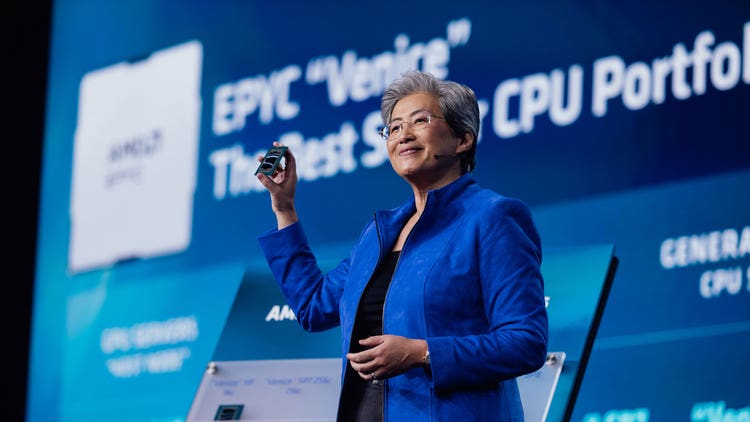
Talk about a big day. At AMD’s Advancing AI event last week, the company:
- Introduced three models of the new 6th Gen AMD EPYC server processor series, codenamed “Venice”
- Announced and gave details on its Helios high-performance AI rack design
- Introduced two new models of its AMD Instinct GPU family
- Announced an AI-optimized version of its AMD ROCm open software platform
- Revealed new partnerships with leading AI suppliers, including Anthropic and OpenAI
That same day, Supermicro announced its H15 server portfolio. These systems are powered by the new 6th Gen AMD EPYC processors, optimized for AMD Instinct GPUs, and connected by AMD Pensando networking.
What are AMD’s ‘Venice’ CPUs?
Venice was the code name for the new 6th Gen AMD EPYC server processor family introduced at the Advancing AI event by AMD’s CEO, Lisa Su (pictured above).
This line of server CPUs, based on AMD’s new ‘Zen 6’ architecture, is fabricated using the latest 2nm technology.
“Compute never stands still,” Su told attendees. She explained that AMD now thinks of server computing as handling three separate workloads: GPU servers, agent sandboxes, and general-purpose computing.
To that end, Venice—now known as the 6th Gen AMD EPYC 9006 processor series—has debuted with models for multiple categories:
- AMD EPYC 9006 SP7: The line’s powerhouse, this processor is for high-density agent sandboxes. You get up to 256 cores and 512 threads per processor, with performance frequency reaching 5GHz.
- AMD EPYC 9006 SP8: A processor designed for efficiency. It can support edge systems, power-constrained racks, smaller clusters and general-purpose servers.
- AMD EPYC 9006X SP7: A processor for high-performance computing (HPC), technical computing and data-intensive workloads that need lots of cache and memory bandwidth.
- AMD EPYC 9006 LP: Formerly code-named Verano, this processor is designed to be an AI host node for rack-scale AI systems.
What’s new with AMD Instinct GPUs?
AMD’s Su also introduced the next generation of the company’s Instinct GPU line. She said the new series offers 4 times more throughput than previous Instincts at low levels, and up to 34 times more throughput at the highest levels. One economic benefit: lower cost per token.
- AMD Instinct MI400 Series: This is AMD’s next generation of data-center GPUs, and they’ve been designed with AI in mind. Two members of the family were introduced: the MI455X for frontier AI and AI factories, and the MI430X for sovereign AI and HPC.
- AMD Instinct MI350P: This is an air-cooled GPU designed for organizations that want to add AI, but don’t want to make major upgrades. “This is the easiest way to add AI to your data center,” said Dan McNamara, AMD’s senior VP of compute and enterprise AI. “It turns your existing data center into an AI data center.”
What is Helios, and when will it be available?
During Lisa Su’s Advancing AI 2026 keynote, she formally announced AMD Helios, the company’s rack-scale AI infrastructure designed for large-scale AI implementations.
As several of the day’s speakers emphasized, the scale and complexity of AI workloads require IT managers to adopt a new mindset. The key system is no longer a single processor, server or even rack, several speakers said. Instead, it’s the entire data center.
To that end, the Helios reference design combines several other AMD products—6th Gen EPYC processors, Instinct MI455X GPUs, ROCm software, and the Pensando “Vulcano” 800 AI NIC—into a unified rack solution. The design is based on open standards, including OCP Open Rack Wide (ORW).
AMD Helios calls for up to 72 AMD Instinct MI455X GPUs on one double-width rack, all of them liquid-cooled. A full AMD Helios rackscale solution delivers up to 1.4 exaFLOPS of FP8 compute, 2.9 exaFLOPS of FP4 compute, and 31TB of HBM4 memory. During her presentation, Su said Helios offers 15% more compute and 50% more scale-out bandwidth than competing solutions.
How has AMD ROCm been optimized for AI?
Also at the Advancing AI event, Vamsi Boppana, AMD’s senior VP of AI, introduced an AI optimized version of ROCm, the company’s open-source software platform.
Called AMD ROCm.ai, its an AI-native development platform for AMD platforms. ROCm.ai combines AI-assisted development, intelligent deployment and software optimization.
ROCm.ai also features a new command-line system called ROCm CLI. It’s used for installing, validating, serving and managing AI workloads.
Also new in ROCm.ai is a new open-source agentic system called Hyperloom. It automates the task of optimizing end-to-end inference workloads.
Regarding performance gains, AMD says ROCm.ai on average delivers a 3.3x inference improvement and 2.4x training improvement over AMD ROCm 7—the latest version of “regular” ROCm—on the same hardware.
Shipments of AMD ROCm.ai are set to begin next month.
Who are AMD’s AI partners?
AI compute is so complicated, Su told the Advancing AI attendees, no single company can do it all. That’s why AMD has partnered with other companies to co-develop and test AI solutions.
These partners feature a veritable who’s who of AI tech, including Anthropic, OpenAI, Meta, AT&T and Cisco.
At the Advancing AI event, AMD’s new partners were represented by high-level execs. These included Anthropic co-founder Tom Brown; OpenAI’s VP of compute strategy, Sachin Kati; Meta’s head of infrastructure, Santosh Janardhan; and AT&T’s CTO, Jeremy Legg.
They were joined by Andrew Feldman, co-founder of a lesser-known AI supplier, Cerebras. His company builds a wafer-scale engine that is being featured on the AMD Helios design.
What is Supermicro doing to support new AMD products?
Fortune favors the fast, and on the same day as Su’s keynote, Supermicro introduced its new H15 line of servers. All are powered by the new 6th Gen AMD EPYC processors, optimized for AMD Instinct GPUs, and connected by AMD Pensando networking.
Supermicro’s new H15 portfolio comprises six lines: Hyper, CloudDC, GrandTwIn, FlexTwin, Petascale Storage, and SuperBlade. These range from single-socket servers to full rack-scale implementations.
In addition, Supermicro is adding these new AMD-powered servers to its Data Center Building Block Solutions (DCBBS) family. That’s Supermicro’s offering for a complete, modular AI infrastructure.
Supermicro is also collaborating with AMD on the Helios rack-scale AI solution. At the Advancing AI event, Supermicro even had a Helios demo in the AMD booth.
Do More:
- Watch a video replay: AMD Advancing AI 2026 presentation
- Learn more: AMD Instinct GPUs
- Get to know AMD Helios
- Learn about AMD ROCm.ai
- Discover the new Supermicro H15 servers